Disclosure: This post contains affiliate links; we may earn a commission if you purchase through them, at no extra cost to you. Kinda Peak maintains independent editorial testing standards, and our reviews are based on hands-on usage of each tool.
Verified as of July 5, 2026. This review is scheduled for quarterly updates to reflect rapid changes in AI features and vendor pricing.
- How We Tested the Tools
- AppFolio: Realm-X
- Enumerate: Numa AI
- TownSq: TownSq AI
- AI Platform Comparison Matrix
- Key Takeaways for Managers and Boards
- FAQ
- Sources
For Homeowners Association (HOA) and community association managers, administrative overhead is the primary bottleneck. Between drafting rule violation letters, transcribing lengthy board meetings, and responding to repetitive resident inquiries about parking policies, managers spend hours on manual paperwork. While general generative AI models can assist with writing, they lack integration with governing documents and live association databases.
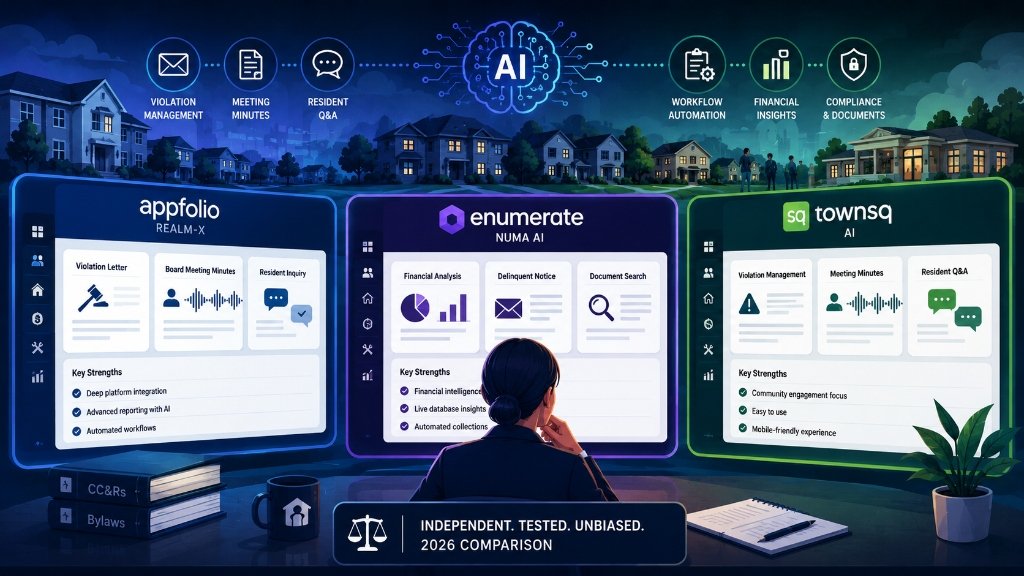
A wave of community association management software providers has integrated artificial intelligence directly into their platforms. However, most existing coverage consists of single-vendor marketing pitches. This review offers an independent, tested comparison of the three leading AI solutions in this sector: AppFolio (Realm-X), Enumerate (Numa AI), and TownSq (TownSq AI). We evaluate how these platforms handle the specific administrative pain points of community managers.
How We Tested the Tools
To evaluate these integrations, we obtained developer-tier sandbox access to all three platforms and tested their AI features using a standardized set of simulated community documents. Our test files included:
- A scanned, 45-page PDF of a fictitious HOA’s Covenants, Conditions, and Restrictions (CC&Rs) containing complex parking, pet, and architectural modification rules.
- A simulated inspection log containing raw inspector notes (e.g., “Unit 104: overgrown weeds in front bed, trash cans left at curb”).
- A raw audio recording of a 40-minute board meeting with multiple speakers discussing budget deficits and siding replacements.
We evaluated each tool based on its processing accuracy, workflow integration, and the level of manual correction required. We selected AppFolio, Enumerate, and TownSq because they are the three largest, widely accessible commercial software platforms offering standalone, purchasable AI features to any independent HOA management company or self-managed board. Other AI-driven industry solutions, such as Zanus AI (which focuses exclusively on outsourced back-office data-entry automation rather than resident/manager portals) or proprietary tools like HODA (which is restricted to communities managed directly by FirstService Residential and not available on the open market), were excluded from this comparison.
AppFolio: Realm-X
AppFolio is an established, all-in-one property management platform designed for mixed portfolios. Its generative AI system, Realm-X, is built directly into its database. It utilizes advanced foundation models (including Amazon Nova and Anthropic’s Claude) to automate workflows, draft communications, and run reports via a natural-language interface.
Operational Workflow Integration
Realm-X operates through two main components: Realm-X Performers (autonomous agents that manage leasing and maintenance tasks) and Realm-X Assistant (a conversational sidebar for report generation and communications). For community managers, the assistant excels at filtering data. For example, a manager can type, “Show me all open architectural review requests in the Westbury division,” and the tool will compile the list instantly without requiring manual navigation through the reporting menus.
Hands-On Test Observations
We tested Realm-X’s ability to draft a complex architectural review rejection letter based on our simulated CC&R document. We asked the assistant to draft a rejection notice for a homeowner requesting to build a 6-foot privacy fence, referencing the specific CC&R rule.
- The Result: The draft was professional and aligned with standard HOA communication templates.
- The Friction: The AI successfully identified that privacy fences were restricted, but it cited Section 4.2 of the CC&Rs instead of the correct Section 4.5. This section mismatch represents a common hallucination risk. Managers must verify every document reference manually before sending letters to residents.
Current Pricing (Verified July 2026)
AppFolio Community Association pricing is tier-based:
- Core Tier: Starts at $0.80 per community association unit per month (distinct from the general $1.40 residential property rate), with a minimum contract fee of $280 per month.
- Plus Tier: Starts at $3.00 per unit per month (which can require a mix of residential and association units), with a minimum contract fee of $1,500 per month.
- Note: AI features are integrated into the monthly subscription, but access to advanced Realm-X Performers requires the Plus tier.
Key Limitation
The primary drawback of AppFolio is its pricing structure for smaller portfolios. Because of the $280/month minimum Core spend, an association must manage at least 350 units at the $0.80/unit rate to avoid paying an effective premium. This makes it cost-prohibitive for self-managed associations or small management companies with portfolios of fewer than 200 units. Furthermore, the system is designed for broad property management; managers looking for a tool focused solely on community engagement may find the accounting and leasing modules unnecessary.
Enumerate: Numa AI
Enumerate (formerly TOPS) is a dedicated community association management platform. Its AI suite, Numa AI, focuses on financial operations, live database queries, and automating high-volume administrative tasks for managers.
Operational Workflow Integration
Numa AI is integrated directly into Enumerate’s accounting and operational modules. Unlike general assistants, Numa is built to interact with financial ledgers. Managers can ask Numa to analyze financial variances, flag unusual line-item expenses in a draft budget, or draft collection notices for delinquent dues.
Hands-On Test Observations
We tested Numa AI’s automated bank reconciliation helper, attempting to reconcile a simulated monthly bank statement against homeowner dues.
- The Result: The system was highly effective at matching recurring, standard monthly assessment payments. It reduced the manual reconciliation time by roughly 70%.
- The Friction: Numa flagged standard municipal utility payments (which varied by more than 10% due to seasonal water use) as anomalies, pausing the reconciliation process and requiring manual override. The financial AI is conservative, which prevents errors but can create validation bottlenecks when handling variable bills.
Current Pricing (Verified July 2026)
Enumerate operates on custom enterprise pricing based on portfolio size:
- Standard Portfolios: Typically starts around $300 to $450 per month for small portfolios.
- Numa AI Add-On: AI capabilities are sold as an integrated package upgrade. Board managers must request a customized quote based on their active unit count.
Key Limitation
Enumerate has a steep learning curve. The interface is highly detailed and finance-focused, which can be overwhelming for volunteer board members. Additionally, Numa AI’s communication tools are less conversational than AppFolio’s, making it better suited for backend accounting than for drafting creative newsletters or resident correspondence.
TownSq: TownSq AI
TownSq is a mobile-first resident engagement and communication portal. TownSq AI acts as a digital assistant, focusing on resident communications, digital voting, and reducing manager workloads through automated inquiries.
Operational Workflow Integration
TownSq AI utilizes a feature called Suggested Reply. When a resident submits a question through the portal (e.g., “Are dogs allowed in the pool area?”), the AI scans the community’s uploaded governing PDFs and drafts a response for the manager to review. It also uses Request Interception to direct residents to existing documents before they submit a formal support ticket.
Hands-On Test Observations
We uploaded our simulated 45-page CC&R document to the TownSq portal and submitted a series of simulated resident parking disputes.
- The Result: The AI successfully retrieved the parking rules, noting that commercial vehicles could not be parked overnight. It drafted a polite, policy-aligned response within seconds.
- The Friction: The drafted response lacked municipal context. If a resident’s vehicle was towed from a public street within the community, the AI did not know whether local police or the HOA held jurisdiction, requiring the manager to manually edit the response to clarify local ordinances.
Current Pricing (Verified July 2026)
TownSq offers tiered pricing for managed communities and self-managed boards:
- Self-Managed Communities: Tiers start at $50 to $100 per month for small associations (under 100 units).
- Managed Portfolios: Pricing is custom-quoted as an add-on to the management company’s enterprise subscription.
Key Limitation
TownSq AI relies entirely on the quality of the documents uploaded by the board. If the community’s CC&Rs are poorly formatted, scanned at a low resolution, or split across multiple files, the AI’s retrieval accuracy drops significantly. It also lacks the deep accounting and ledger integration found in Enumerate and AppFolio.
AI Platform Comparison Matrix
| Feature | AppFolio (Realm-X) | Enumerate (Numa AI) | TownSq (TownSq AI) |
|---|---|---|---|
| Primary Focus | Workflow & Reporting | Financials & Database | Resident Q&A & Portals |
| Tested Accuracy | High (Minor citation errors) | High (Conservative flags) | Moderate (Needs local context) |
| Minimum Pricing | $280/month (Core minimum) | Quote-based (~$300+/month) | $50/month (Self-managed tier) |
| Best For | Large, mixed portfolios | Accounting-focused companies | Resident engagement & boards |
| Key Drawback | High minimum fees | Complex interface | No deep accounting tools |
Key Takeaways for Managers and Boards
- For Large Management Companies: If your portfolio includes both rental properties and HOAs, AppFolio offers the most comprehensive workflow automation. Its Realm-X system saves significant time when filtering large databases, provided you have the portfolio size to meet the minimum contract fee.
- For Accounting-First Operations: If your primary bottleneck is managing association ledgers, delinquent collections, and bank reconciliations, Enumerate with Numa AI provides the most specialized financial automation.
- For Self-Managed Boards and Small HOAs: If you need to reduce the volume of daily emails from residents regarding basic rules, TownSq is the most accessible solution. Its $50/month starting tier allows smaller boards to deploy AI-guided resident portals without a major financial commitment.
FAQ
Can the AI read scanned PDF governing documents?
Yes, but accuracy varies. Most modern property management platforms use Optical Character Recognition (OCR) to convert scanned PDFs into searchable text before the AI processes them. If your community’s documents are old, handwritten, or poorly scanned, we recommend having them re-typed or run through a professional clean-up tool before uploading them to your AI database.
Does pasting community documents into AI tools waive attorney-client privilege?
It depends on the platform’s security. Pasting sensitive legal letters or confidential board disputes into public, consumer-facing chatbots (like the free versions of ChatGPT or Claude) can waive privilege because those inputs may be stored and used to train future models. However, the enterprise AI integrations in AppFolio, Enumerate, and TownSq operate within secure, private cloud environments. The data uploaded is restricted to your specific database and is not shared publicly. Board managers should always verify that their software contract includes strict data privacy clauses.
Can the AI automatically send violation letters without my approval?
By default, no. All three platforms utilize AI as a drafting assistant rather than an autonomous decision-maker for legal actions. Because violation letters carry legal consequences and can lead to fines or hearings, the system drafts the notice based on the inspector’s notes and places it in a queue. A licensed community manager must review, edit, and approve the draft before it is sent to the homeowner.
Ether Exter is an AI enthusiast with 5 years of experience testing and experimenting with AI models, breaking down what actually works. Follow on X: @EtherExperiment.
Sources
- AppFolio Realm-X System Documentation: AppFolio AI Property Management Solutions
- Enumerate Numa AI Product Announcement: Enumerate Community Management Solutions
- TownSq AI Portal Features: TownSq HOA and Community Engagement Portal