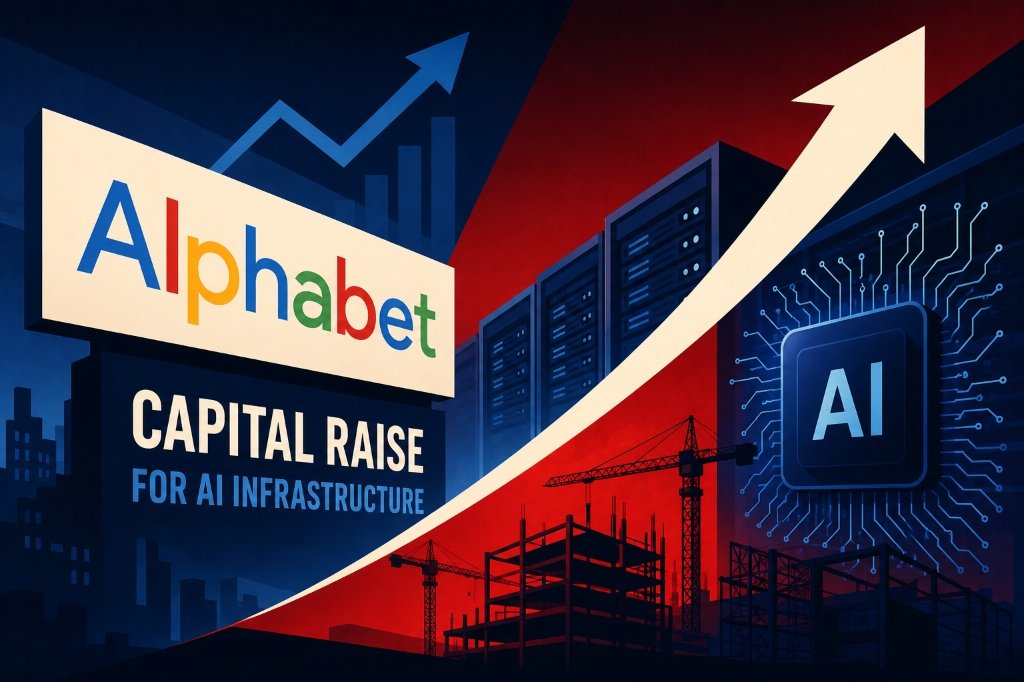
Alphabet Inc. changed its capital strategy in June 2026 by launching an equity offering. The company is raising cash to build specialized compute centers. This shift signals that search ad revenue cannot fund the hardware needs of the intelligence race.
Table of Contents
- The Equity Offering: Structural Details
- The Capital Expenditures Spike: Hardware Economics
- Shareholder Dilution: Investor Perspectives
- Berkshire Hathaway Stake: Value Endorsement
- The Compute Moat: Moat Strategy
- Capital Structure Metrics
- Key Takeaways
- FAQ
- Related Articles
- Sources
The Equity Offering: Structural Details
Alphabet priced an upsized capital raise of 80 billion dollars in June 2026. The structure divides the capital into underwritten shares, an at-the-market program, and a private placement. The board earmarked the cash to buy graphic chips, build data centers, and secure electricity contracts.
Investors tracked the three main parts of this capital stack. The company issued 30 billion dollars in public shares and depositary certificates representing convertible preferred stock. Google executives also created a 40 billion dollar at-the-market program to sell shares during the second half of 2026. The final 10 billion dollars came from a direct sale to a single institutional backer.
The Capital Expenditures Spike: Hardware Economics
Alphabet expanded its 2026 capital budget to a range of 180 billion to 190 billion dollars. This capital target represents a sixfold increase over historical corporate infrastructure spending. Management directed the funds to build training clusters and purchase proprietary tensor processing units.
The scale of this budget highlights a shift in tech finance. Standard cash flow from operations generated 174 billion dollars over the trailing twelve months. Because infrastructure requirements now exceed this cash flow, the company must dilute equity to fund the gap. Engineers need immediate computing capacity to train frontier reasoning models, forcing the board to seek external capital.
Shareholder Dilution: Investor Perspectives
The announcement of the capital raise divided the investor community on platforms like Hacker News and Reddit. Shareholders debated the long-term returns of diluting public equity for hardware buildouts. Some observers viewed the move as an admission that search cash flows are insufficient.
One investor on r/stocks noted the scale of the funding shift: “If a company with 174 billion dollars in operating cash flow needs to dilute shareholders by 80 billion, it tells you the AI Capex cycle has completely outgrown standard corporate balance sheets.” Other stock analysts pointed out that the dilution represents less than two percent of the total market capitalization of the firm.
Berkshire Hathaway Stake: Value Endorsement
Warren Buffett’s investment group anchored the private placement with a 10 billion dollar stock buy. Berkshire Hathaway representatives built on a position they initiated during late 2025. This backing provided validation for the massive infrastructure plan.
The transaction reduced initial market concerns about dilution. Stock traders viewed the purchase as proof that the underlying search business remains cheap. Buffett’s team avoided common tech hype, selecting Alphabet based on its computing assets and distribution advantages. This move indicates that institutional investors view computing infrastructure as a capital asset with tangible utility.
The Compute Moat: Moat Strategy
Google executives are using the capital raise to set a high financial barrier for competitors. By spending nearly 200 billion dollars on infrastructure, the firm prevents smaller players from entering the frontier model market.
This concentration of compute resource changes the startup landscape. Instead of training foundation systems, software startups must rent access from hyperscalers. Developers argue that the high cost of chips creates dependency. The capital raise secures the hardware layer, ensuring that few companies can compete at the frontier of intelligence.
Capital Structure Metrics
The table below breaks down the components of the Alphabet capital raise and its core target destinations.
| Funding Component | Capital Amount | Funding Structure | Primary Destination |
|---|---|---|---|
| Public Offering | $30 Billion | Underwritten shares | Graphic processors & TPUs |
| ATM Program | $40 Billion | At-the-market sales | Tax obligations & operations |
| Private Placement | $10 Billion | Berkshire Hathaway sale | Long-term data centers |
| Total Raise | $80 Billion | Equity capital raise | Infrastructure expansion |
Key Takeaways
- Alphabet launched an 80 billion dollar capital raise to support its capital expenditures budget.
- The company expects 2026 infrastructure spending to reach 180 billion to 190 billion dollars.
- Berkshire Hathaway anchored the equity raise with a 10 billion dollar private placement.
- Cash flow from search ads is no longer sufficient to fund the computing needs of the AI race.
- High hardware costs prevent smaller startups from training competitor frontier models.
FAQ
The Alphabet Capital Raise
Alphabet raised 80 billion dollars through equity offerings in June 2026. The capital will fund graphic processors, TPUs, data centers, and power supply contracts for artificial intelligence model training.
Shareholder Dilution Concerns
The offering dilutes current shareholders by less than two percent. However, investors debate if the long-term returns on data centers justify issuing new equity instead of using operational cash.
Berkshire Hathaway Google Investment
Berkshire Hathaway purchased 10 billion dollars in shares through a private placement. This purchase increased the position they established in late 2025, signaling long-term support for the capital plan.
Alphabet Compute Spend Scale
The company guided 2026 capital expenditures to a range of 180 billion to 190 billion dollars. The board expects this budget to increase during 2027 to meet compute demand.
Related Articles
- OpenAI Lost $20.9 Billion. The $17.2B Going to Microsoft Is the Real Story.
- Why OpenAI’s New ‘Jalapeño’ ASIC Chip Is Nvidia’s Worst Nightmare
Sources
- Alphabet Investor Relations SEC Filings: https://abc.xyz/investor/
- Berkshire Hathaway Annual Reports: https://www.berkshirehathaway.com/
- Nasdaq Capital Markets Data: https://www.nasdaq.com/
- Hacker News Discussion on Hyperscaler CapEx: https://news.ycombinator.com/