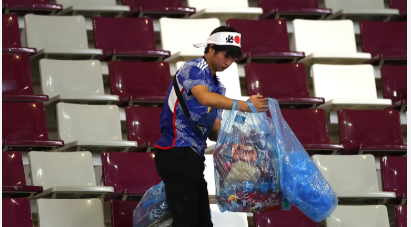
On June 14, 2026, Japan drew 2-2 with the Netherlands at Dallas Stadium in Arlington, Texas. Daichi Kamada headed in an 88th-minute equalizer from a Koki Ogawa corner to steal a point. The blue trash bags the fans had been waving in celebration during the goal were repurposed for garbage collection within twenty minutes of the final whistle.
NFL quarterback Jameis Winston — in Arlington as a Fox Sports correspondent for the tournament — grabbed a bag and joined them. The stadium workers who normally spend hours cleaning up after Dallas Cowboys games reportedly had almost nothing to do.
What They Did in the Stands
Hundreds of Japanese fans cleaned their section of Dallas Stadium after the match — trash bags in hand, picking up cups, wrappers, and anything left behind. The Japanese men’s team left their locker room spotless as well. Chairs were stacked, trash was collected, and towels were left neatly folded in the center of the room. The pink and orange bibs players and coaches wore for stadium clearance were stacked by the door.
Workers at AT&T Stadium — home of the Dallas Cowboys, where staff usually have considerably more post-match cleanup duty — had almost nothing left to handle.
One fan explained the behavior to FIFA’s official camera: “That’s the culture. It’s like respect for everything — respect for the players, supporters, and also for the stadium. We are honored to be here, so we don’t want to make the mess and then leave it.”
Twenty-year-old fan Eita Tanaka told AFP the habit starts in school: “Japanese people think that when we use a certain place, we were told that you have to make that place look tidier when you leave than it was when you arrived. For example, at school in our classrooms we tidy it up after ourselves without our teacher telling us.”
Nina Shimaguchi of the Japan American Society of Dallas-Fort Worth wasn’t surprised. “The value of cleaning up is a sign of respect and the habit starts young,” she said. She added that the viral moment creates a secondary effect: “Through the game, probably many people see, ‘Oh that’s the culture.’ And that’s the next step of people trying to learn, trying to know… that kind of positivity remains.”
Why This Keeps Happening at Every World Cup
The tradition dates back to Japan’s World Cup debut in France in 1998. It continued in Germany, South Africa, Brazil, Russia, Qatar — and now Texas. Japan are appearing at their eighth straight World Cup and their fans’ cleanliness has become their international calling card.
The cultural mechanism behind it has a name: sociologist Ohsawa described it as “reading the air.” “In Japan, even if one person starts picking up litter, those around them feel they simply cannot help but join in,” he said, adding that peer pressure is the primary social force — not necessarily a desire to clean the stadium, but “a desire not to be seen as a nuisance in one’s own group.”
The 2018 Belgium match made the behavior famous in a different way. Japan lost in the final minutes of a knockout round. The fans cleaned the stadium anyway. The players left a handwritten thank-you note in the dressing room. Qatar 2022 added a new layer — Japanese fans cleaned their section after a match Japan wasn’t even playing, joining the cleanup during the opening fixture between Qatar and Ecuador.
The contrast with European fan culture from the same tournament is hard to miss. Following PSG’s UEFA Champions League victory in May, 90 people were detained across France, 57 police officers were injured, and one person died on the Paris ring road after rioters attempted to set up a blockade. Japan drew 2-2 and its fans swept the bleachers.
The Yellow School Bus, the Chips, and the American Experience
The cleanup wasn’t the only thing going viral. Social media has been flooded with accounts from Japanese fans experiencing Texas for the first time, and the culture shock is running in both directions.
One fan documented his reaction to seeing a yellow American school bus in person — a vehicle he had only ever encountered in movies and television. He was, by multiple accounts, genuinely thrilled.
Another fan bought a standard American bag of potato chips at a convenience store, held it up in disbelief, and posted asking whether this size was considered normal. It is. He was not prepared for this information.
The story that has spread furthest involves a fan’s written account of his first encounter with free chips and salsa at a Texas restaurant. Confused by the concept of food arriving before he had ordered — and before he had, in his words, “earned” it — he reportedly stopped the waiter to clarify the situation. The waiter explained it was complimentary. The fan, still uncertain about the ethics of free pre-meal food, began eating anyway. As the basket was refilled, he kept eating. By the time his actual meal arrived, he described himself as a “ruined man” who had been “defeated by a courtesy.”
This is the most accurate description of chips and salsa at a Texas restaurant ever written by anyone from any country.
What Comes Next
Japan play Tunisia in Mexico on Saturday, then return to Dallas Stadium in ten days to face Sweden. If history is any indication, they’ll do what they did before: leave the stadium spotless.
The trash bags with “Japan Pride” printed on them serve a dual function — waved as flags during goals, repurposed for garbage collection after the final whistle. The same object used to celebrate a Kamada header becomes the tool for cleaning up the evidence that anyone was ever there.
That detail is either a beautiful metaphor for Japanese civic culture or the single most efficient piece of stadium merchandise ever designed. Probably both.
About the Author
Your 31-year-old cousin who has watched every World Cup since 2002, cried at the 2018 Belgium game, and has been sending everyone the chips and salsa essay since yesterday with no other context because it genuinely does not need any.