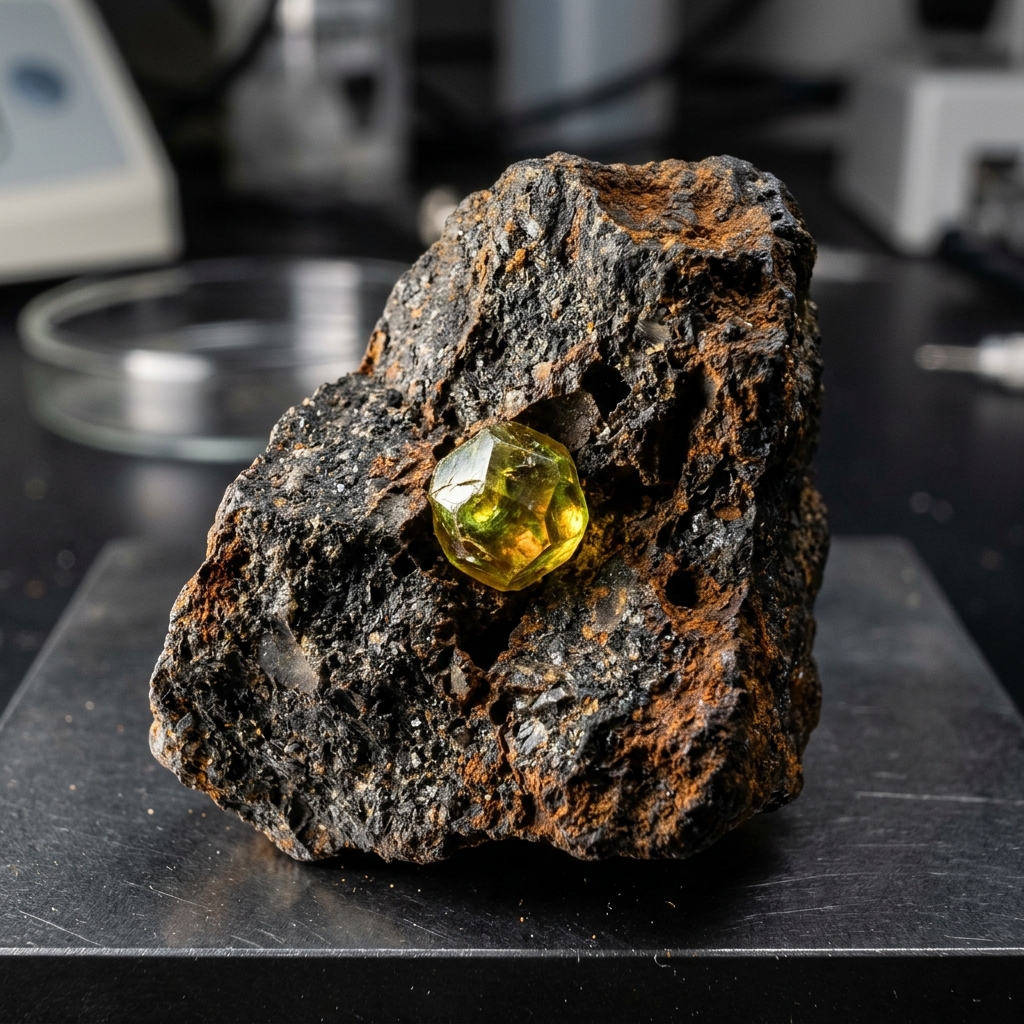
The Gemstone Nobody Expected to Find on Mars
Every few years, a discovery slips out of a university press office so quietly that the internet almost doesn’t notice — then someone with a science background reads the abstract and the whole thing explodes. The garnet inside Martian meteorite NWA 8171 is one of those discoveries.
An international research team led by planetary geologist Tanya Kizovski of Brock University, working alongside the Royal Ontario Museum, has confirmed the first-ever identification of garnet in a Martian sample. Tiny grains of andradite — an iron-rich variant of garnet measuring roughly 0.8 by 0.5 millimeters — were hiding inside a fragment of NWA 8171, a basaltic Martian meteorite sitting quietly in the ROM’s collection while researchers walked past it for years. The findings were published in the peer-reviewed journal Geochemical Perspectives Letters in June 2026.
The grains are yellow-green. Not the deep red of a jeweler’s showcase, not the dark crystal you’d expect from a science-fiction prop department. Yellow-green, translucent, and roughly the size of a grain of fine sand. The research team initially assumed they were looking at pyroxene, a far more common Martian mineral, before follow-up spectroscopic analyses forced them to completely revise that assumption.
Why Garnet on Mars Is Actually Shocking
The reason this matters requires about thirty seconds of geology context. On Earth, garnet doesn’t simply crystallize out of thin air. It forms under specific, demanding conditions: intense heat and pressure deep inside the mantle, aggressive chemical alteration by hydrothermal fluids, or the brute-force shock of a major meteorite impact.
Before this discovery, none of those formation pathways had been confirmed as operating on Mars. The planet has long been treated as a geologically simpler world than Earth — volcanically active in its ancient past, but not a place where the complex pressure-and-temperature windows required for garnet formation were considered plausible based on available evidence. The NWA 8171 fragment punches a hole straight through that assumption.
Tanya Kizovski’s team describes garnets as “geological storytellers.” The mineral traps a precise chemical record of the temperature, pressure, and fluid chemistry present at the exact moment of its formation. That record survives for billions of years. Finding one inside a Martian meteorite means Mars is holding a geological diary entry that scientists haven’t been able to read before — and the implications for understanding what the red planet actually looked like during its early history are considerable.
What NWA 8171 Actually Is
The meteorite itself deserves a quick description, because the way Kizovski’s team characterizes it matters. NWA 8171 is a basaltic breccia — essentially, a rock made of angular fragments of older rock cemented together by heat or impact pressure. The researchers compare it to a fruitcake: a dense base material studded with mineral inclusions of different ages and origins.
That structure is what made the garnet so easy to miss. Breccias are geologically messy by nature, packed with minerals that shouldn’t necessarily coexist. A tiny yellow-green crystal grain, 0.8 by 0.5 millimeters, sitting inside a rock already full of mineral variety, looks like background noise until you run the right tests.
The meteorite was recovered in Northwest Africa — hence the NWA designation — and has been catalogued and studied for years without anyone running the precise spectroscopic analysis that ultimately revealed the andradite. The discovery is a reminder that planetary science museums are holding geological evidence whose full significance hasn’t been decoded yet.
Three Possible Explanations — All of Them Significant
Kizovski’s team lays out the main formation scenarios currently under consideration. Each one tells a different story about Mars’s interior.
Volcanic Metasomatism
Garnet can form when volcanic fluids carrying dissolved minerals percolate through existing rock and chemically alter it. If this is what happened, it implies Mars once hosted hydrothermal systems active and chemically aggressive enough to produce garnet-grade alteration. That’s a more geologically dynamic early Mars than most current models describe.
Impact Shock Metamorphism
High-velocity meteorite impacts generate extreme short-duration pressure spikes. On Earth, impact shock metamorphism produces some unusual minerals. If the andradite in NWA 8171 formed this way, it’s a record of a specific impact event — one powerful enough to momentarily recreate the pressure conditions garnet requires. The geometry of a basaltic breccia actually makes this scenario plausible, since breccias are often the product of impact events themselves.
Deep Crustal Pressure
The third option is the one with the largest implications: Mars’s crust, at certain depths and during certain thermal periods in its early history, may have generated the pressure and temperature conditions required for garnet formation through standard metamorphic processes. That would mean the Martian interior was geologically complex in ways that current planetary models have systematically underestimated.
The research team is now examining isotope ratios in the sample to confirm definitively that the garnet is Martian in origin rather than terrestrial contamination, and to narrow down which formation mechanism is responsible.
What This Changes About Mars
The popular image of Mars as a dead, frozen, geologically exhausted world has been eroding for years. The Curiosity rover identified ancient organic molecules. Perseverance found evidence of ancient river deltas. The InSight lander confirmed the planet still experiences marsquakes. Now a meteorite in a Toronto museum reveals that Mars once hosted the conditions required to crystallize gemstone-grade minerals.
Looking closely at the cumulative trajectory of these discoveries, the picture that emerges is of a planet whose geological history is substantially more complex than the simplified “early volcanic activity followed by cold dead silence” narrative that dominated planetary science for decades. Each new finding chips away at the assumption that Mars was always Earth’s simpler cousin.
The garnet also has implications for the astrobiology question that nobody states outright but everyone is thinking. The formation pathways for andradite — especially the hydrothermal metasomatism scenario — involve liquid water chemistry. Hydrothermal systems, on Earth, are among the most productive environments for microbial life. Finding mineralogical evidence that such systems may have operated on Mars doesn’t confirm anything about ancient Martian biology. It just makes the question harder to dismiss.
Why the Research Team Almost Missed It
The detail buried in Kizovski’s paper that most science writers glossed over is the near-miss. The team initially identified the grains as pyroxene and moved on. It was only during follow-up hyperspectral analysis that the readings refused to match the pyroxene signature. At that point, the researchers ran a broader mineral identification sweep, and the andradite signal appeared.
The implication is uncomfortable: if this particular team hadn’t run the follow-up analysis on this particular fragment of this particular meteorite, the first confirmed garnet in a Martian sample would still be sitting in a museum drawer labeled as something mundane. How many other samples in how many other collections are holding similarly misclassified evidence?
Sources
- Kizovski et al., Geochemical Perspectives Letters (2026): First identification of garnet in a Martian meteorite sample
- Royal Ontario Museum Press Release: ROM and Brock University announce Martian garnet discovery
- ScienceAlert: Scientists Discover Garnet in a Mars Meteorite For The First Time
- University of Portsmouth: Research partners on Martian garnet confirmation study
About the Author
Your cousin who dropped out of astrophysics after two semesters but maintains seven open browser tabs about Mars at all times, keeps a labeled meteorite collection in a shoebox under their bed, and once got into a thirty-minute argument at Thanksgiving about whether Olympus Mons technically counts as a mountain.