The public narrative surrounding generative artificial intelligence remains relentlessly bullish. Tech giants and startups alike present large language models as friction-free productivity accelerators. Behind closed doors, however, the corporate entities most publicly enthusiastic about AI are facing a sudden economic reckoning. Companies are discovering that while traditional software scales with predictable subscription fees, agentic AI tools run on consumption-based token pricing that can drain IT budgets at an alarming rate.
- The Hype Cycle: From Tokenmaxxing to Tokenminimizing
- The Economic Reality: SaaS Seats vs. Token Consumption
- The Tesla Controversy: Self-Dealing and the xAI Exemption
- A Market-Wide Retreat
- Devil’s Advocate: Is This Just Standard Expense Control?
- Summary
- FAQ
- Sources
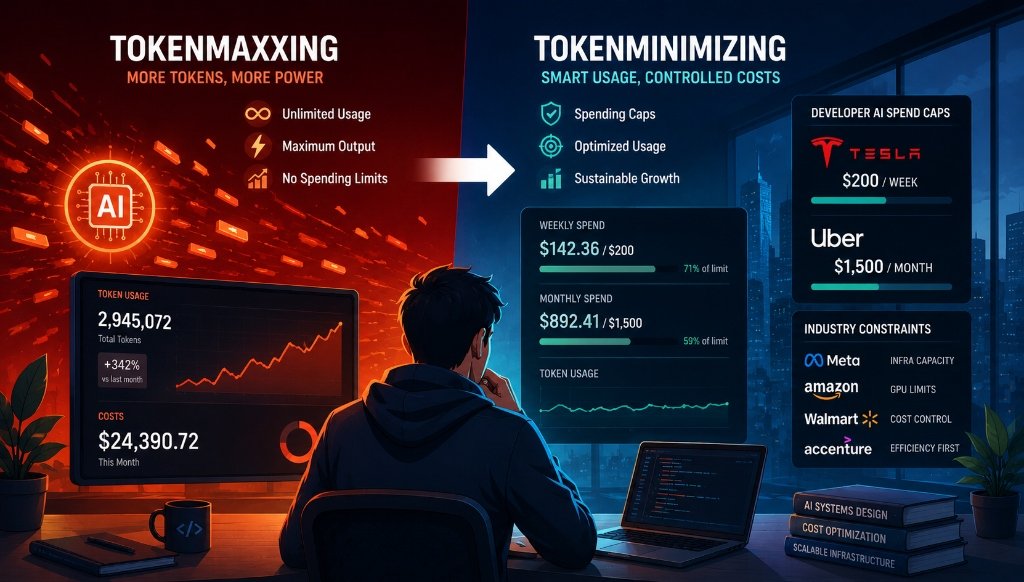
In response, major tech firms are slamming the brakes. According to original reporting by The Information, Tesla has implemented an internal cost-control policy limiting employee AI tool spending to $200 per week, effective July 6, 2026. Any expenditure exceeding this cap requires direct manager sign-off. This restriction comes shortly after Uber took similar measures earlier this year, quietly establishing a $1,500 monthly cap per developer for AI coding tools. Uber’s decision followed a bruising four-month period in which the ride-hailing company reportedly exhausted its entire annual AI budget.
The Hype Cycle: From Tokenmaxxing to Tokenminimizing
To understand how enterprise AI spending spiraled out of control, one must look at the corporate culture of late 2025 and early 2026. For months, upper management at several Silicon Valley firms aggressively pushed AI adoption as a key performance indicator. This led to a phase of “tokenmaxxing,” where high AI utilization was celebrated rather than managed.
This pressure created a fertile ground for grassroots competition. At Meta and Amazon, employees themselves built informal intranet dashboards and gamified leaderboards - such as Meta’s Claudeonomics and Amazon’s KiroRank - to rank engineering teams by their raw token consumption. While these tools were created by employees seeking to drive awareness of AI acceleration, they quickly turned into peer-pressure mechanisms that rewarded raw volume. Amazon explicitly stated to the Financial Times that the KiroRank tool was “not an official or approved tool,” but rather a grassroots effort. Rather than a top-down corporate mandate, this bottom-up gamification resulted in widespread malicious compliance, forcing leadership to step in and shut down the unsanctioned dashboards.
As one Reddit user observed, “in Silicon Valley there was a huge push by upper management to show ‘AI Adoption’ so they started measuring AI spend. So engineers just starting using scripts and chrome extensions to endlessly” consume tokens. Another developer on the platform echoed this sentiment, suggesting that “a lot of employees did malicious compliance and ask AI everything, down to how to lift a pencil.”
The Economic Reality: SaaS Seats vs. Token Consumption
The core issue is structural. Traditional enterprise software relies on SaaS (Software-as-a-Service) licensing, where a company pays a fixed, predictable monthly fee per seat. If a developer uses Microsoft Word or Slack ten thousand times in a month, the cost remains unchanged.
AI coding tools like Cursor or Anthropic’s Claude Code operate differently. They are heavily dependent on raw token consumption, meaning that every single query, execution run, and context-window reload scales the cost linearly. An automated agent running in a loop can query a model hundreds of times in minutes, compounding costs without direct human oversight. This creates a severe AI productivity paradox, where tools intended to save time end up consuming vast sums of capital.
| Software Model | Pricing Structure | Cost Predictability | Scaling Risk |
|---|---|---|---|
| Traditional SaaS | Per-seat, flat monthly fee | High | Low (fixed per user) |
| Developer AI Tools | Consumption-based, per-token | Low | High (linear scaling per run) |
This structural pricing shift makes developer experimentation highly volatile. When engineers transition from simple completion prompts to multi-agent workflows, their token usage multiplies. With companies already grappling with high ChatGPT operating costs, the raw cost of running these developer queries has forced executives to demand strict spend controls.
The Tesla Controversy: Self-Dealing and the xAI Exemption
While Uber’s cap was a straightforward cost-cutting exercise, Tesla’s new policy has sparked internal controversy due to a glaring carve-out. The Information reports that Tesla’s $200 weekly cap explicitly exempts beta versions of products from xAI, Elon Musk’s private artificial intelligence venture, such as its Grok chatbot and Composer development tool.
This exemption has frustrated Tesla’s engineering staff. Multiple internal reports indicate that Tesla’s software engineers heavily prefer Anthropic’s Claude for writing code, whereas adoption of Grok remains low. By capping competing products like Claude and ChatGPT while keeping xAI tools completely free to use, Tesla is using its internal spending limits to funnel developer usage toward Musk’s other business.
Critics point out the corporate governance issues at play here. Exposing engineers to strict caps on their preferred development tools can hinder day-to-day productivity. Meanwhile, funneling their activity toward xAI’s beta tools serves as a free training and testing pipeline for xAI, raising questions about whether Tesla is prioritizing its own operational efficiency or xAI’s product development.
A Market-Wide Retreat
Tesla and Uber are not alone in this retreat from unrestricted token spending. A broader, quiet pullback is happening across the corporate tech sector.
- Meta and Amazon have reportedly shut down their Claudeonomics and KiroRank leaderboards, shifting their focus from raw consumption to strict return-on-investment metrics.
- Walmart has introduced strict limits on the number of daily queries employees can run on its proprietary internal AI assistants to manage cloud processing costs.
- Accenture has issued usage guidance instructing consultants to avoid deploying generative AI for tasks that can be solved with traditional, lower-cost programming methods, describing the inflection point of unpredictable cloud API bills.
This widespread introduction of caps highlights a shift in corporate sentiment. The era of open-ended AI experimentation is over. In its place is a disciplined phase of governance, where enterprises must manage their token spend just as tightly as they manage their servers and personnel.
Devil’s Advocate: Is This Just Standard Expense Control?
Some industry analysts argue that weekly or monthly AI spend limits are no different than standard corporate policies for travel expenses, software licensing, or mobile phone usage. Capping discretionary spend is a routine part of running a large business.
However, this comparison misses the fundamental nature of token-based tools. Traditional corporate caps are placed on discretionary expenses that do not directly impact core work output. A software engineer’s IDE (Integrated Development Environment) is not a discretionary expense; it is the primary tool of their trade. Capping token usage on an IDE is equivalent to capping the number of lines of code an engineer is allowed to write or the number of compilations they can run.
Because consumption-based AI tools are integrated directly into the developer workflow, restricting tokens creates an artificial ceiling on developer velocity. As companies try to parse whether AI actually saves them money, these caps may solve the immediate budget blowout while introducing a hidden, costly bottleneck in software delivery.
Summary
The shift toward tokenminimizing highlights the gap between public AI marketing and the hard math of cloud computing. As companies like Tesla and Uber enforce weekly and monthly boundaries, the industry must adapt to a new normal. Developer velocity will no longer be measured by how many tokens are consumed, but by how efficiently those tokens are used.
FAQ
What is the $200 weekly cap at Tesla?
Tesla capped developer spending on third-party generative AI tools like OpenAI’s ChatGPT and Anthropic’s Claude at $200 per week. Any spending above this limit requires prior manager approval.
Why did Tesla exempt xAI’s tools from the spending limits?
Tesla’s policy explicitly exempts beta products from xAI (Elon Musk’s private AI firm), such as the Grok chatbot and the Composer developer assistant, to encourage internal adoption of xAI tools.
How did Uber manage its AI tool budget?
After exhausting its entire annual AI budget in four months, Uber introduced a flat $1,500 monthly limit per employee for each AI coding tool (like Claude Code and Cursor) to control consumption-based pricing bills.
What is the difference between SaaS and token-based pricing?
Traditional SaaS pricing charges a flat, predictable fee per user per month. Token-based pricing scales linearly with usage, meaning every prompt, test run, or database query increases costs, exposing companies to massive budget overruns.
Why did Meta and Amazon shut down their internal AI leaderboards?
Meta and Amazon shut down grassroots, employee-created leaderboards (such as Claudeonomics and KiroRank) because they promoted “tokenmaxxing” - where developers gamed the system by querying AI models excessively to improve their team’s usage stats, causing API costs to spike.
Sources
- Tesla’s internal memo and spend cap reporting: The Information
- Uber’s AI budget exhaustion and monthly limits reporting: The Information
- Analysis of enterprise cost shifts: ITPro
- Developer community sentiment: Reddit technology discussions