Claude Code and the Trust Crisis of Terminal-Agent Steganography
This article explores the intersection of client-side developer tooling, automated prompt telemetry, and enterprise data security. By examining the technical mechanisms of steganographic prompt watermarking discovered in compiled binaries, we trace the friction between IP protection and developer trust.
The Discovery: Unicode Swaps and the XOR 91 Key
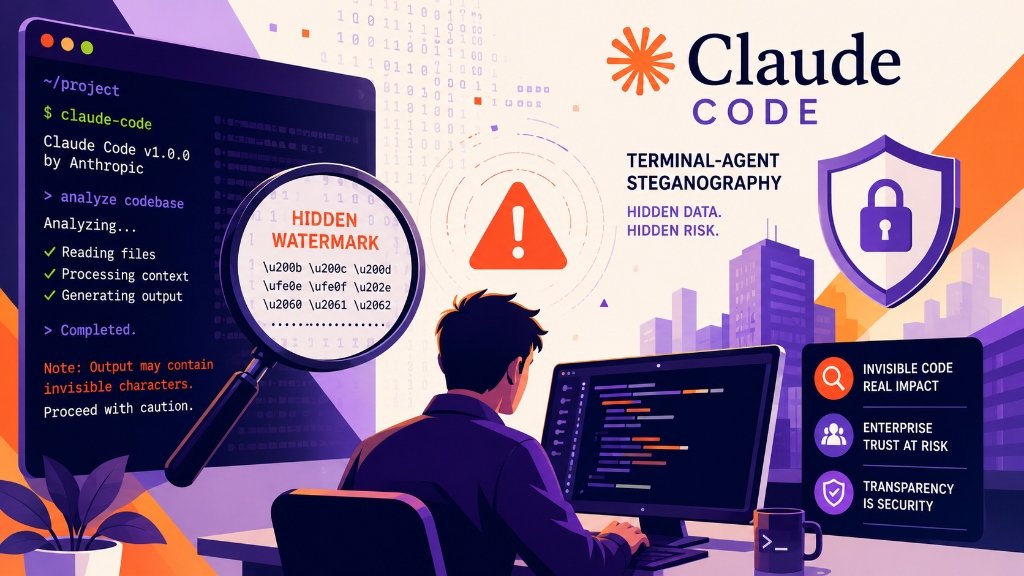
The controversy surrounding Anthropic’s command-line agent began with a technical teardown of the compiled JavaScript binary for version 2.1.196. An independent developer publishing on Thereallo discovered that the local CLI tool was silently modifying the text of system prompts before sending them to the API. Unlike standard tracking methods that rely on HTTP headers, environment variables, or explicit metadata payloads, this mechanism operated directly on the text of the prompt.
The execution of this mechanism relied on character substitution. The tool modified the date string that introduces the system prompt (typically starting with “Today’s date is YYYY-MM-DD”). If specific triggers were met, the standard apostrophe (') in “Today’s” was replaced with visually indistinguishable Unicode alternatives, such as the Right Single Quotation Mark (U+2019), the Modifier Letter Apostrophe (U+02BC), or the Modifier Letter Prime (U+02B9). For users working in standard terminal environments or code editors, these characters appeared identical to a standard apostrophe, but the API endpoint receiving the prompt could detect the precise Unicode variant instantly.
Beyond character swaps, the code inspected the local system timezone. If the environment report returned specific timezones (including ‘Asia/Shanghai’ or ‘Asia/Urumqi’), the date separator in the system prompt was changed from a hyphen (-) to a forward slash (/). The target configuration was obfuscated inside the binary to evade static analysis, using a Base64-encoded string list decrypted at runtime with an XOR key of decimal value 91. This list contained ~19 obfuscated domains representing not just rival AI labs like Zhipu, Moonshot, and DeepSeek, but a broader scope of Chinese tech infrastructure and commercial resellers. The targets included companies like Alibaba, ByteDance, Baidu, JD.com, Xiaohongshu, Bilibili, and iFlytek, as well as multiple proxy services and API gateways. When the tool detected it was running through these hostnames, the Unicode switches were triggered.
For developers, this client-side rewriting represents a departure from standard API practices. When a local CLI tool alters the literal text of a request to signal telemetry to a remote server without exposing the changes to the terminal output, the boundary between utility and tracking channel becomes blurred.
Anti-Distillation vs. Silent Telemetry
The technical structure of the watermarking suggests it was implemented to combat model distillation and API reselling. Distillation is the process where a developer uses a frontier model (like Claude) to generate training data to refine a smaller, competing model. Major AI labs forbid this practice in their terms of service, as it allows competitors to copy capabilities at a fraction of the original training cost. The rising traffic from black-market API tokens has made tracing the origin of prompts a priority for model providers.
By steganographically marking the prompts, Anthropic could flag when their CLI tool was redirected to unauthorized proxy servers or competing endpoints. Because the watermarks were embedded directly in the prompt text, they survived even if the request was forwarded through multiple intermediate servers or stripped of HTTP headers. The system could trace the request back to the specific version of the local CLI client that generated it, identifying reselling operations and distillation pipelines.
However, the implementation of this defense triggered significant trust issues within the open-source and developer community. Even if the intent was intellectual property protection, the method utilized undisclosed, invisible changes to user-submitted text. In professional software development, predictability is a requirement. Developers expect that the tools running in their terminal do not modify data payloads in secret.
The lack of disclosure and the absence of an opt-out flag created friction. Many developers argued that if a tool can silently swap Unicode characters to mark prompts, it could theoretically make other changes to code files or command arguments. The controversy highlights a growing tension: as AI companies seek to protect their models from exploitation, the security measures they deploy locally can resemble the behavior of telemetry pipelines or spyware.
Alibaba’s Workplace Ban and Enterprise Risk
The enterprise response to this discovery was swift. Following reviews of the prompt steganography code, Reuters reported that Alibaba implemented a strict ban on Claude Code across its corporate network. The company cited potential backdoor vulnerabilities and the risks of unauthorized local code modification.
For large enterprises, command-line agents present a unique security challenge. Unlike browser-based chat boxes, terminal utilities require deep integration with the developer’s local environment. A terminal agent routinely reads the file structure, modifies source code files, and executes shell commands. If such an agent also contains hidden, obfuscated logic that alters its behavior based on network conditions or timezones, it introduces an unvetted vector into the development pipeline.
Enterprise security teams look for strict predictability. The discovery that Claude Code could dynamically alter system prompt payloads based on the value of the ANTHROPIC_BASE_URL environment variable raised flags. If the CLI tool can scan environment variables and adjust its prompt output steganographically, security teams must consider what other environment inputs could trigger undocumented behaviors.
The ban by Alibaba represents a broader trend of corporate caution toward agentic coding. The productivity gains of vibe coding workflows are offset by the risk of letting closed-source binaries execute code inside secure developer networks. When these tools are found to contain hidden tracking features, the risk calculation for enterprise security teams shifts toward prohibition.
It is worth noting that while these findings are well-corroborated, no independent cybersecurity firm has published a formal security audit of Claude Code’s telemetry. The technical details trace back to a single developer’s reverse-engineering report, which was then validated by the developer community on Reddit and Hacker News, and partially confirmed by Anthropic engineers. For security-conscious organizations, this lack of transparent, third-party certification is itself a caveat that encourages cautious adoption.
Trust and the Extent of Client-Side Agency
The debate over prompt watermarking exposes a deeper concern regarding the limits of AI agency. Terminal-based utilities like Claude Code represent a transition from passive assistants to active agents. These tools do not just suggest code; they plan, write, run tests, and commit changes to git repositories. They operate with a high degree of local authority.
This authority is built entirely on trust. Developers grant these agents access to their local terminals because they expect the tool to act as a predictable executor of their instructions. When the agent is discovered to have a secondary, hidden set of instructions (such as marking prompts to detect proxies), that trust is damaged.
The steganography discovery shows that client-side agents are still tied to the business interests of the model provider. A local utility is not just serving the user; it is also serving as a sensor for the company’s platform. This dual role creates a conflict of interest. If a developer cannot verify what the binary is doing under the hood because the code is compiled and obfuscated, the tool becomes a security liability.
This has renewed the push for open-source alternatives in the agentic space. While closed-source models often lead in raw reasoning capability, open-source CLI scaffolding allows teams to audit every line of code running locally. In secure environments, the ability to inspect the local agent’s codebase is becoming more valuable than marginal gains in reasoning score.
Policy and the Call for Transparent Telemetry
The resolution of the steganography controversy requires a clear distinction between user telemetry and security defenses. Telemetry is a common feature in modern software, but it is typically governed by opt-in dialogs, transparent configuration files, and clear documentation. Hidden modifications of user prompts do not meet these standards.
To rebuild trust, developers are demanding transparent options to manage telemetry. The industry consensus is that any local tracking must be fully documented, with clear opt-out flags (such as a disable-telemetry configuration variable). Furthermore, any anti-distillation watermarking should be handled on the server side, rather than through compiled client-side binaries that manipulate text payloads in secret.
Anthropic partially confirmed the telemetry program’s existence and purpose shortly after its disclosure. Thariq Shihipar, a Claude Code engineer at Anthropic, clarified on X that the prompt-marking system was “an experiment we launched in March… meant to prevent account abuse from unauthorized resellers and protect against distillation,” adding that the development team had already been “meaning to take this down for a while.” This statement confirmed the community’s technical analysis of the binary. It also demonstrated that developers hold significant leverage over AI tooling providers. In an ecosystem where alternative coding assistants are readily available, companies cannot afford to alienate the developer community with undisclosed tracking methods.
The lessons of this controversy will shape the next generation of developer agents. As AI systems become more agentic and integrated into local environments, transparency is not just an ethical preference; it is a technical necessity. Without it, terminal-based AI tools will continue to face bans in secure corporate settings, limiting their adoption to non-critical development environments.
The Evolution of Developer Tooling Security
The prompt steganography incident will likely lead to stricter sandboxing of terminal agents. In the future, developer environments may run AI CLIs inside isolated containers with restricted access to environment variables and system network configuration. This approach would allow developers to use agentic tools without exposing their entire system to potential telemetry loops.
Ultimately, the controversy serves as a reminder that the tools we use to write software are themselves software, subject to the same security, privacy, and policy standards as the applications we build. As we delegate more agency to AI tools, auditing those tools becomes a critical step in the software supply chain.
Ether Exter is an AI enthusiast with 5 years of experience testing and experimenting with AI models, breaking down what actually works. Follow on X: @EtherExperiment.
Sources
- Primary Technical Analysis: Thereallo Blog - Claude Code Prompt Steganography
- Corporate Security Action: Reuters - Alibaba to ban Claude Code in workplace over backdoor risks