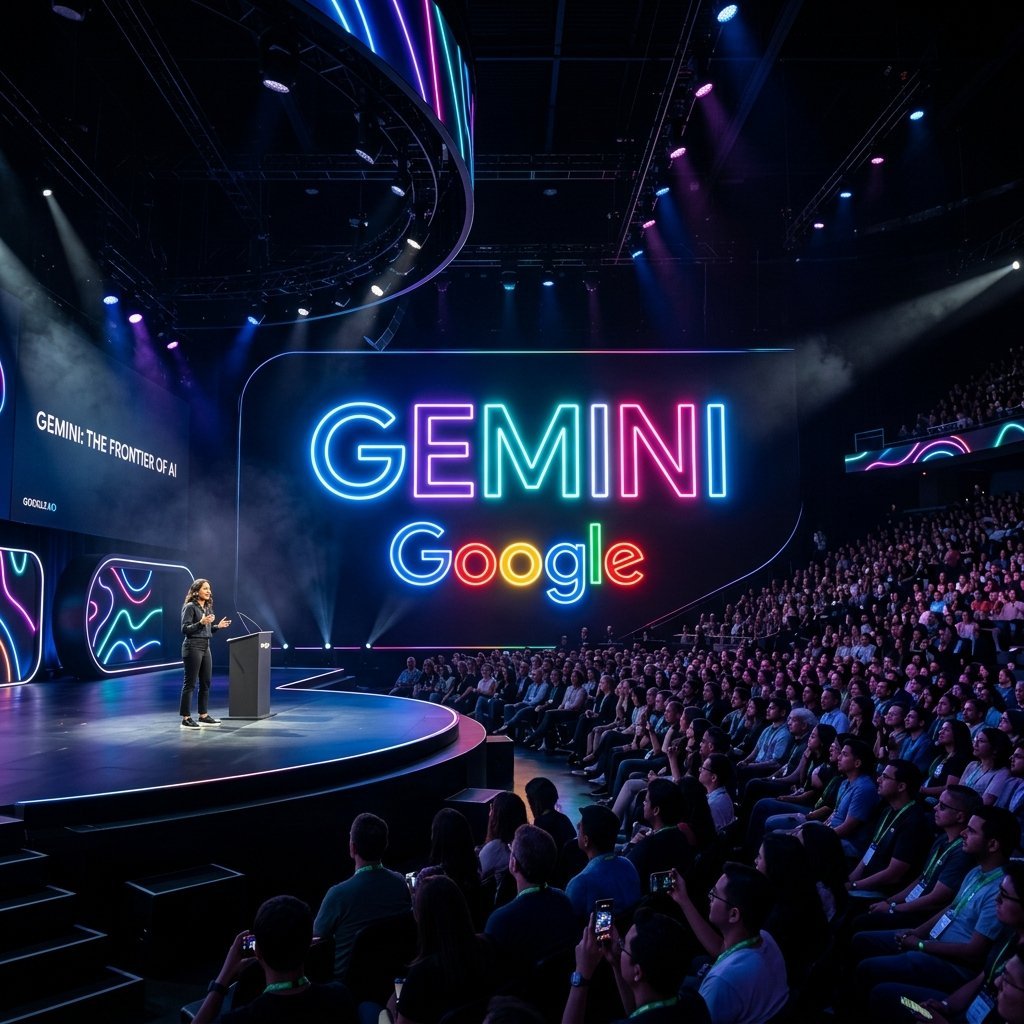
Google just spent its entire keynote proving that text-based search engines are obsolete. Standing on the stage at Google I/O 2026, the company laid out a vision where the web browser is no longer a tool for finding pages, but an execution environment for active software agents. The announcement docket, which spanned over twenty updates in a single afternoon, marks Google’s most aggressive push to transition from informational retrieval to active task execution.
The strategic shift is clear. Google is no longer selling models; they are deploying systems designed to run in the background. By embedding parallel agent architectures directly into the browser search bar and upgrading local developer environments, Google aims to lock users into an ecosystem where the distinction between writing software, browsing the web, and editing media disappears.
The Death of the Search Box: Google Search Redesigns for Agentic Coding
For the first time in twenty-five years, the Google search engine is discarding its classic design. The input box no longer functions as a simple parser for text strings. Instead, users can submit combinations of image files, audio tracks, active browser tabs, and screen recordings directly into the query field. The system processes these inputs as a unified prompt, analyzing visual context alongside literal text.
The primary engine of this redesign is real-time code generation. When a user queries a technical topic or asks how a mechanical system functions, Google Search does not return list results. Instead, it writes and executes code in the background to build a custom interactive simulation directly inside the search results page.
Real-Time Code Execution in the Browser
The search interface has transitioned to a generative UI framework. If a user asks to track a custom fitness routine, build a home moving plan, or visualize an astrophysical concept, the search engine constructs a functional mini-app on the fly. These generated modules pull real-time data, including live maps and localized weather feeds, to assemble custom dashboards.
Google announced that these interactive browser simulations will roll out globally during the summer of 2026, operating entirely free of charge for the public. The strategic goal here is simple: bypass the standard software distribution pipeline by generating single-use web applications instantly.
Search Agents and the 24/7 Labor Force
In addition to temporary interface generation, Google is embedding persistent AI agents directly into the search bar. These agents execute tasks in the background on a continuous loop, monitoring specified directories, tracking product releases, or scanning local directories for updates.
For example, a user can instruct a search agent to track a specific sneaker release date or scan for booking openings at a local venue that matches precise parameters, such as a private karaoke room with late-night food service. The agent runs on Google Cloud, meaning it executes these checks continuously without requiring the user to keep a browser window or laptop open. Once the condition is met, the agent triggers a direct notification.
Gemini Omni and the Simulation of Reality
The core foundation of Google’s new multimodal capabilities is Gemini Omni, paired with the lightweight Gemini Omni Flash model. While early generative models focused on predicting subsequent tokens of text, Omni is engineered to simulate physical reality by reasoning across multiple mediums simultaneously.
Gemini Omni Flash combines spatial reasoning with automated video generation. Most historical AI video tools relied on text prompts that yielded abstract visuals lacking physical consistency. Gemini Omni, however, uses its underlying knowledge base of physical laws to ensure generated outputs match real-world dynamics.
Gemini Omni Flash: From Prompt to Scientific Claymation
To demonstrate this physical reasoning, Google showed a single-sentence generation prompt: “Make a claymation explainer of protein folding, don’t use hands or stop motion, and make it accurate.”
Running on the Flash Extended architecture, the system generated a scientifically accurate animation showing amino acid chains folding into helices and sheets. The visual representation matched the accompanying audio narration in real time. The system compiled the entire video, including the script, scientific facts, and visual animation, from that single text input, without relying on external reference papers.
Daily Brief and the Workspace Integration
Gemini Spark represents Google’s attempt to build a persistent personal assistant deeply integrated into the Google Workspace suite. The assistant monitors Gmail inboxes, Google Calendar schedules, and Google Docs files to coordinate personal logistics.
A primary touchpoint for this assistant is the Daily Brief feature, located on the left taskbar of the redesigned Gemini application. Daily Brief scans calendar events and incoming mail every morning, prioritizing urgent tasks and compiling follow-up details into a single morning summary.
In a live demonstration, Gemini Spark monitored a school calendar, noted that a child had a game scheduled for the next morning, identified that the parent was responsible for bringing snacks, and automatically added the appropriate grocery items to an Instacart cart, pausing only to request payment confirmation.
Antigravity 2.0: The Parallel Multi-Agent Developer Console
For software developers, the most significant announcement was the launch of Antigravity 2.0. The desktop application has been redesigned, abandoning the complex terminal windows, code editors, and file trees of version 1.0. The new interface is built around a single chat prompt, supported by three navigation options on the sidebar: new conversation, history, and scheduled tasks.
Antigravity 2.0 functions by coordinating multiple agent pipelines in parallel. Instead of running a single sequence of instructions, the developer prompts the main interface, which then delegates components of the problem to specialized sub-agents. These sub-agents build code, run test cases, analyze build errors, and debug execution problems simultaneously.
Vibe Coding and the Death of IDEs
To test this multi-agent coordination, developers prompted Antigravity 2.0 with a single instruction: “Make a Chrome Dino Infinite Runner game that plays itself in a cyber theme.” The system used Gemini 3.5 Flash as the underlying model.
flowchart TD
    A[Developer Input] --> B(Antigravity 2.0 Orchestrator)
    B --> C[Visual Agent<br>Cyber Theme]
    B --> D[Physics Agent<br>Jumping Physics]
    B --> E[AI Player Agent<br>Self-Playing Brain]
Within four seconds, the orchestrator agent generated a comprehensive architecture plan covering the visual elements, cyber theme CSS styling, collision physics, and an AI-driven self-playing brain. After the user approved the plan, the agents began writing the code. The only manual input required was a single permission click to allow the local system to execute the build.
Stitch and the Design-to-Code Pipeline
When the game initially failed to load in the browser, developers simply typed: “This is not working. Please make it work.” The Antigravity sub-agents traced the console logs, modified the physics loop, and reloaded the page automatically.
When the self-playing AI player kept crashing into obstacles, the system detected the failures via the active browser process, rewrote the obstacle detection logic, and stabilized the gameplay loop without further developer intervention.
This approach aligns with Google’s broader “vibe coding” push in Google Flow, where users build software modules by describing features in plain English. The interface, supported by Stitch, allows real-time streaming of UI designs directly onto a digital canvas. Designers can import existing Figma files, netlify codebases, or local sites, edit specific visual components using targeted AI prompts, and export the finished assets directly to Netlify, Lovable, or Bolt.
The Hardware Frontier: Android XR and Samsung Smart Glasses
Google is also expanding its runtime environment onto user faces. Partnering with Samsung, Google announced a line of smart glasses powered by Android XR, a unified spatial computing operating system.
The smart glasses are designed to move the agent interface off the desktop and into the physical environment. The hardware comes in two variants:
| Variant | Input Method | Core Function |
|---|---|---|
| Audio Glasses | Haptic frame tap, voice prompt | Spoken assistance, turn-by-turn navigation, real-time audio translation |
| Display Glasses | Spatial tracking, voice prompt | AR visual overlays, review displays for passing businesses, hands-free media capture |
By deploying Android XR across a shared hardware ecosystem, Google is positioning itself to challenge Meta’s wearable lineup, offering direct integration with Google Maps, Google Search, and local Gemini agents.
Verification and Security: SynthID and Content Watermarking
As generative media tools become more sophisticated, the risk of unverified deepfakes increases. Google addressed this by scaling its SynthID watermark technology.
SynthID embeds an invisible watermark directly into the metadata and pixel arrays of generated media. Google revealed that SynthID has watermarked over 100 billion images and videos. The company is now integrating SynthID verification directly into Google Chrome and Google Search, allowing users to inspect content credentials to see if an image was captured with a camera or modified using AI tools.
Comparing Google’s New Agent Ecosystem
To understand how these tools fit together, look at the feature breakdown of Google’s new agent platforms:
| Platform | Target Audience | Primary Interface | Core Function | Run Environment |
|---|---|---|---|---|
| Gemini Spark | General Consumers | Workspace (Gmail/Docs) | Personal logistics, calendar tracking, daily scheduling | Google Cloud |
| Antigravity 2.0 | Software Developers | Chat Console | Parallel multi-agent code generation and debugging | Local & Cloud |
| Google Flow | Creative Content Creators | Video Editor | Vibe coding, automated video sizing, assets editing | Browser |
| Pome Agent | Small Business Owners | Business Dashboard | Brand identity books, automated site hosting, marketing | Google Cloud |
Sources
- Google I/O 2026 Keynote Presentation: Official announcements and live demonstrations, May 2026.
- Google DeepMind Research: Project Genie and Weather Next technical documentation.
- Google Developer Documentation: Antigravity 2.0 and Stitch API specifications.