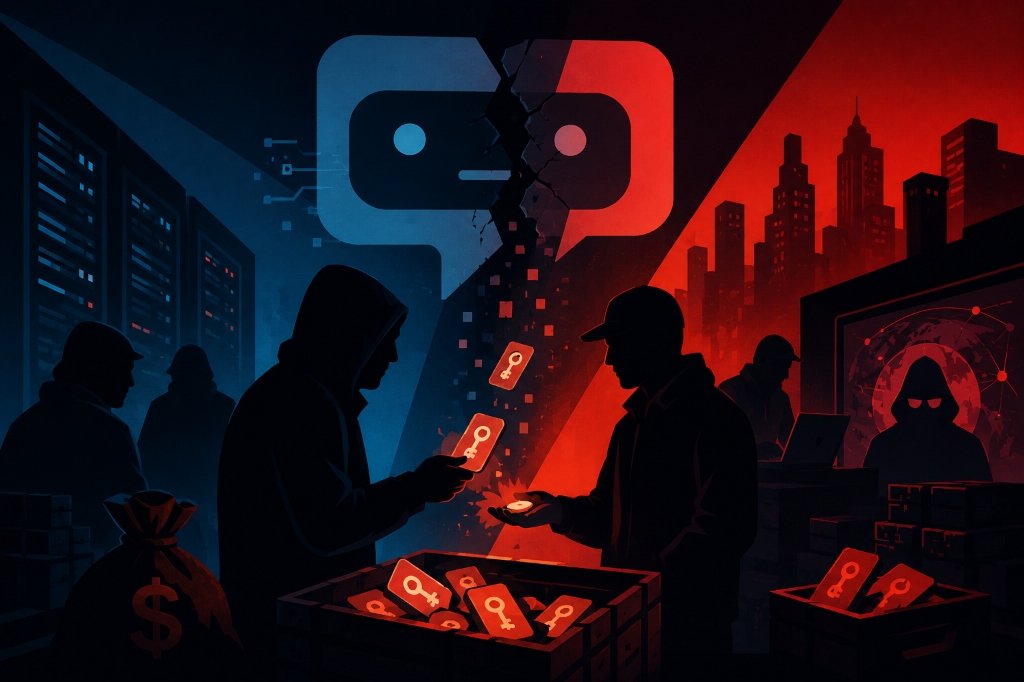
A shadow API economy in the digital underbelly offers developers premium access to frontier models at a fraction of retail prices. Chinese resellers advertise high-end model tokens at discounts ranging from 70% to 90% below Anthropic’s rates. Bypassing geo-blocks and safety checks, this grey market operates a complex supply chain of account farms, synthetic identity documents, and stolen consumer subscriptions.
- Transit Stations in the Shadow API Economy
- Bypassing KYC and Identity Verification
- The Economics of Discounted API Tokens
- The NPM Malware Connection to Stolen Subscriptions
- Key Takeaways
- FAQ
- Sources
Transit Stations in the Shadow API Economy
Transit stations are proxy nodes that act as intermediaries between users behind firewalls and Western artificial intelligence providers. These nodes route API requests from restricted territories like China through unblocked intermediate servers, mask traffic origins, and return model outputs.
They operate like virtual private networks (VPNs) but route API payloads. The systems bypass export controls and provider IP bans to open a gateway for developers and malicious actors.
Resellers frame these services as alternative routers, mimicking public aggregators while operating outside compliance frameworks. By routing traffic through these nodes, operators see every prompt and response.
Bypassing KYC and Identity Verification
Account merchants bypass identity verification using anti-detect browsers, automated verification bypasses, and synthetic credentials. Using bulk registering networks, they spin up thousands of developer accounts daily to defeat the three pillars of user verification.
Registering accounts requires neutralizing network-level detection. Creators use anti-detect browsers rather than simple browser automation libraries, presenting authentic device fingerprints and residential IP proxies that look like typical consumer traffic.
Virtual SIM services bypass phone verification, selling SMS codes for less than a cent. When providers require government documents for Know Your Customer (KYC) checks, merchants buy synthetic IDs on Telegram. Sellers supply fake passports and driver’s licenses featuring valid Machine Readable Zone (MRZ) checksums.
If bots require live face scans, brokers hire locals in developing nations to scan their faces for small fees. The brokers then package these scans and sell them to technology developers in Beijing.
The Economics of Discounted API Tokens
Resellers cut costs and lower token prices through model spoofing, payment fraud, and the resale of user-submitted training data. While buyers believe they are purchasing direct access to frontier models, they receive downgraded compute streams.
Resellers main tool is model spoofing, which routes queries to cheaper models. A reseller advertises premium access to Claude Sonnet but routes the request to Haiku or an open-source platform.
| API Service | Advertised Model | Actual Underlying Model | Accuracy on MedQA Benchmark |
|---|---|---|---|
| Official Provider API | Claude 3.5 Sonnet | Claude 3.5 Sonnet | 83.8% |
| Reseller Shadow API | Claude 3.5 Sonnet (Claimed) | Model Spoofing / Haiku / Flash | 37.0% |
The swap degrades performance on specialized benchmarks. Tests show that while official APIs score highly on medical benchmarks, shadow APIs exhibit a drop in accuracy because the query goes to inferior models.
Stolen credit cards fund the premium accounts, yielding pure profit before providers shut down the accounts. Operators also harvest text inputs submitted by developers, selling the training pairs to regional labs to fund their model development programs.
The NPM Malware Connection to Stolen Subscriptions
Infected npm packages carry scripts that steal API keys from developer machines. These dependency chain attacks propagate through public libraries, compromise developer environments, and hijack paid subscriptions.
The Shy Halude worm family exemplifies this tactic. Once a developer installs an infected package, the script scans local directories for active environment variables and API keys. The script then runs a background process, using the machine as a local transit station.
Resellers route queries through these victim machines to exploit their paid limits. The victim wonders why their usage limits disappear, unaware that their machine serves as a node in a global shadow API network.
Key Takeaways
- Chinese resellers offer Claude tokens at 70% to 90% below official prices in a shadow API economy.
- Proxy servers called transit stations allow developers behind geographic blocks to bypass export controls.
- Account farms defeat KYC checks using anti-detect browsers, cheap SMS pools, and synthetic passports sold on Telegram.
- Resellers maintain low prices by model spoofing, substituting cheaper models like Haiku for premium models.
- Infected package manager dependencies like the
Shy Haludeworm hijack developers’ paid subscriptions to run background queries. - Shadow API operators harvest and sell user query logs to regional labs looking to train competitor models.
FAQ
Transit Stations in the AI Gray Market
A transit station is an intermediary server that acts as a proxy, routing API queries from countries with geographic restrictions to Western AI providers. This allows developers behind firewalls to access models like Claude or GPT-4o while hiding their actual location from the providers.
Economics of Cheap API Tokens
Resellers cut costs by routing queries to cheaper models (model spoofing), using stolen credit cards for payment, and pooling paid account subscriptions. They also harvest the user queries and sell them as training data to domestic research labs, offsetting the cost of the tokens.
Model Spoofing Explained
Model spoofing occurs when a shadow API provider claims to run a premium model, such as Claude Sonnet, but silently routes the user’s query to a cheaper, lower-performing model like Haiku or a smaller open-source model, pocketing the difference in cost.
Malware Key Theft Mechanics
Malware like the Shy Halude worm is distributed through infected open-source packages in package managers like npm. Once installed, it scans the developer’s system for stored credentials, steals their API keys, and routes external queries through their paid account.