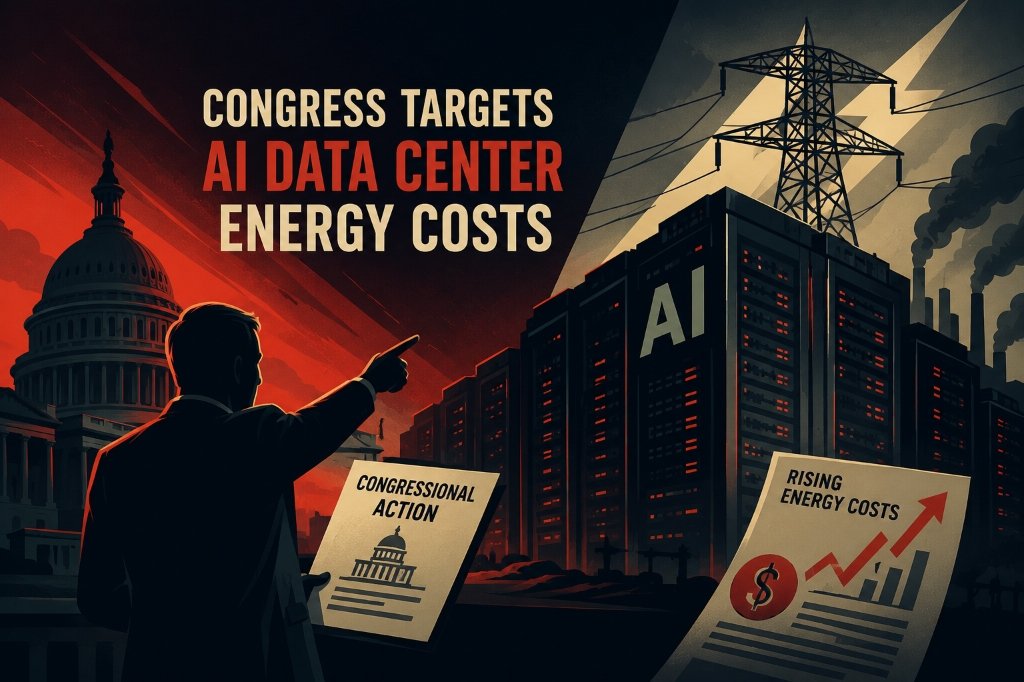
Running a single chat session with a generative model feels weightless, but the physical infrastructure backing it is starting to snap under the load. Bipartisan lawmakers in Washington are drafting legislation designed to prevent tech monopolies from shifting the multi-billion dollar cost of utility grid upgrades onto the shoulders of ordinary taxpayers. As server farms consume a larger share of the national power supply, the race for artificial intelligence dominance is triggering a quiet pocketbook crisis for average households.
- Why Is Congress Targeting AI Data Center Energy Costs?
- How Much Electricity Do AI Data Centers Actually Consume?
- What Is the Real-World Impact of “AIflation” on Consumer Prices?
- Who Pays for Big Tech’s Infrastructure Expansion?
- Key Takeaways
- FAQ
- Sources
Why Is Congress Targeting AI Data Center Energy Costs?
Bipartisan lawmakers are targeting AI data center energy costs to prevent technology companies from socializing the massive capital expenditures required to upgrade local power grids. The proposed draft legislation mandates that data center developers, rather than residential utility ratepayers, fund the new substations, high-voltage lines, and generation capacity needed to run automated systems.
The federal push comes as local public utility commissions struggle to manage the explosive expansion of server facilities. In regional hubs like Northern Virginia—the data center capital of the world—the local grid operator PJM Interconnection has had to queue dozens of new transmission projects just to keep pace with demand. Under current utility regulations, the cost of building these new transmission lines is distributed across the entire regional pool of customers. This means a family living in a suburban townhouse is actively subsidizing the high-density cooling systems of a nearby hyper-scale facility.
Federal regulators are warning that this model is unsustainable. By shifting the financial burden back to the operators, Congress aims to force tech giants to internalize the actual cost of their computing runs. If the bill passes, it will force a significant revision in how firms calculate the operational margins of their large-scale software products.
How Much Electricity Do AI Data Centers Actually Consume?
AI data centers consume roughly ten times more electricity per square foot than traditional enterprise data centers, primarily due to the intense computational demands of hardware accelerators. While a standard search query utilizes a fraction of a watt-hour, generating a single paragraph of text or a short video utilizing a frontier neural network can draw enough power to run a household appliance for several minutes.
Looking closely at the data, the energy requirements scale exponentially when moving from simple database lookups to active model inference and training loops. The grid footprint of these facilities is projected to double by the end of the decade, absorbing a significant portion of national electricity generation in developed markets.
| Computation Type | Est. Energy Consumption per Query | Hardware Required | Relative Grid Impact |
|---|---|---|---|
| Standard Google Search | 0.3 Wh | Commodity CPU Clusters | Baseline (1x) |
| Basic LLM Chat Generation | 3.0 Wh | NVIDIA H100 / Custom ASIC | Moderate (10x) |
| Complex Agentic Workflow (RAG) | 30.0 Wh | High-Density GPU Nodes | Severe (100x) |
| Frontier Model Training (Single Run) | 10,000,000,000 Wh | Custom Clusters (Tens of Thousands of GPUs) | Global Footprint |
To mitigate these staggering costs, tech companies are exploring custom hardware. OpenAI recently co-designed its own LLM-optimized custom silicon named Jalapeño in partnership with Broadcom to slash server operations costs. However, even with hardware efficiency gains, the sheer volume of queries continues to drive aggregate demand upward. The total energy draw of the sector is no longer a rounding error in national infrastructure planning; it is the dominant factor driving new power plant construction.
What Is the Real-World Impact of “AIflation” on Consumer Prices?
The real-world impact of AI-driven inflation manifests as rising consumer prices for everyday electronics, automobiles, and home electricity. Because hyper-scale data centers compete for the same global supply chains of semiconductors, electrical transformers, and copper, they drive up input costs for unrelated consumer manufacturing sectors.
This structural squeeze is particularly visible in the consumer electronics sector. Gaming giants like Sony, Nintendo, and Microsoft are finding themselves outbid for fabrication capacity at leading silicon foundries like TSMC, where high-margin server chips are prioritized over low-margin consumer hardware. The result is a supply bottleneck that has contributed to price increases for next-generation consoles and automotive microcontrollers.
At the same time, the physical cost of electricity is rising. Utilities that are forced to build natural gas peaker plants and upgrade transmission networks to accommodate nearby server clusters are passing those capital costs directly to consumers in the form of higher monthly rates. This dynamic represents a direct transfer of wealth from regular consumers to the balance sheets of technology monopolies, making everyday life more expensive for families who may never even use generative software.
Who Pays for Big Tech’s Infrastructure Expansion?
Big Tech’s infrastructure expansion is currently funded through a combination of subsidized utility rates, tax incentives, and capital expenditures that are increasingly straining corporate cash flows. While companies like Microsoft and Alphabet present their infrastructure investments as independent capital outlays, the underlying support structures are heavily supported by public resources.
The economic reality of running these platforms is beginning to weigh on corporate structures. As we analyzed in our deep dive on OpenAI’s financial dependencies, the cost of compute is the single largest drag on profitability. To keep these systems online, tech giants have spent the last three years building data centers at a pace that has triggered a localized backlash from Dublin to Phoenix.
When a municipal grid operator is forced to rebuild a substation to feed a new campus, the tech company pays a connection fee, but the long-term maintenance of that infrastructure is integrated into the public utility rate base. Bipartisan congressional action represents the first serious attempt to legally block this practice. By forcing tech firms to build their own dedicated power generation—or pay a surcharge that covers the full public cost of the grid upgrades—lawmakers are attempting to protect the consumer from paying the bills of the AI boom.
Key Takeaways
- Bipartisan legislation in Congress aims to prevent technology giants from shifting data center power grid upgrade costs onto residential utility ratepayers.
- AI computation is roughly ten times more energy-intensive than traditional database search, requiring massive infrastructure expansion.
- High foundries demand for AI silicon is creating foundries bottlenecks, raising prices for consumer video game consoles and cars.
- Localized power grids in key hubs like Northern Virginia are facing severe capacity constraints and transmission backlogs.
- Current regulations distribute transmission build costs across all customers, forcing regular households to subsidize hyper-scale facilities.
FAQ
How does an AI data center affect my monthly electricity bill?
Under current utility billing structures, the costs of upgrading regional power lines and building new substations to support data centers are distributed across all customers. This means residential utility ratepayers pay higher monthly rates to subsidize the infrastructure upgrades required by nearby server farms.
What does the bipartisan AI energy bill do?
The proposed draft bill in Congress changes how utility upgrade costs are allocated. It requires hyper-scale data center developers to pay the full capital cost of the power grid upgrades their facilities necessitate, legally blocking them from distributing those costs to regular residential rate bases.
Why do AI models require so much more electricity than normal web searches?
Traditional search queries involve looking up static data on commodity servers. Generating text, image, or video with a neural network requires active, real-time matrix multiplication across thousands of power-hungry GPUs or ASICs, drawing ten times more power per query than database search.
How is the AI boom driving up the price of game consoles?
AI data center accelerators and consumer video game consoles compete for the same limited manufacturing capacity at foundries like TSMC, as well as the same pool of electrical components and raw materials. High demand for server silicon allows foundries to charge premiums, driving up production costs for consumer electronics.
Sources
- U.S. House of Representatives Committee on Energy and Commerce Draft Legislation
- PJM Interconnection regional transmission expansion planning reports
- Federal Energy Regulatory Commission data center grid interconnection filings
- TSMC foundries allocation reports and consumer electronics semiconductor supply chain studies