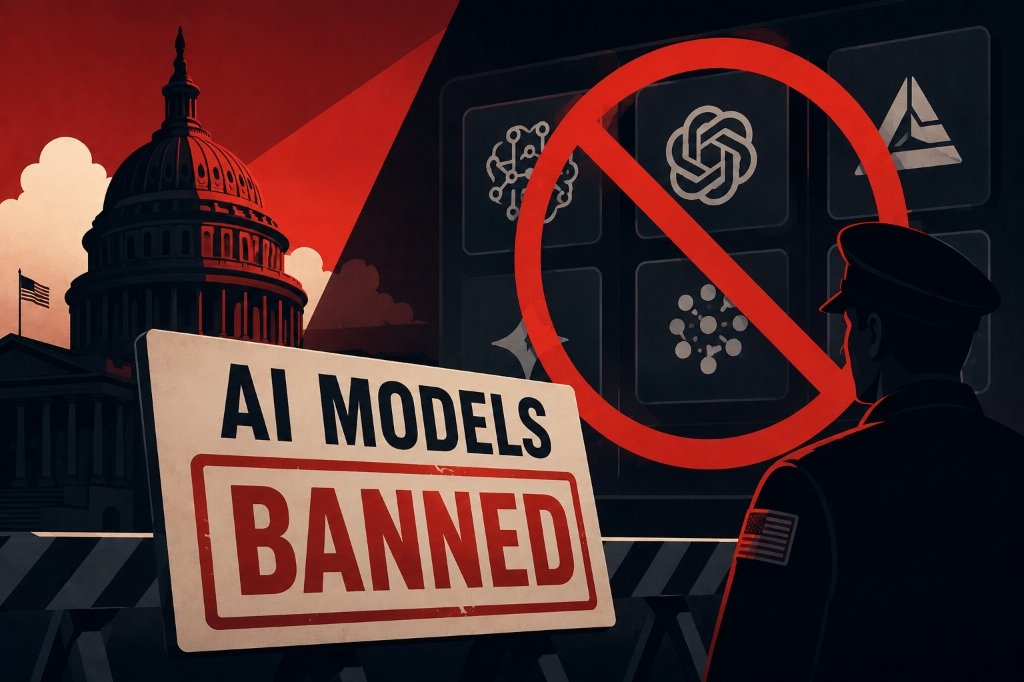
The United States policy on artificial intelligence has taken a restrictive turn. By banning frontier models and limiting access to a chosen corporate whitelist, regulators risk splitting the economy into a permanent intelligence underclass. This staggered licensing regime threatens both software innovation and system safety.
Table of Contents
- Federal Banned List: Model Restrictions
- The Cantillon Effect: Access Inequality
- Safety Blind Spots: Regulating Outputs Over Labs
- The Threat to Open Source: Criminalizing Weights
- Financial Fallout: Impact on Compute Valuations
- The Path Forward: Lab Audits and User Licensing
- Comparison of Regulatory Approaches
- Key Takeaways
- FAQ
- Sources
Federal Banned List: Model Restrictions
The US government has placed restrictions on five prominent frontier models, including Mythos 5, Fable, and the newly developed GPT 5.6 series. Rather than targeting specific bad actors, the strategy imposes a sweeping delay on model releases while regulators conduct safety audits.
Banned Models and Status
The table below lists the primary models affected by the government order and their current operational status.
| Banned Model | Creator Lab | Official Status | Regulatory Mechanism |
|---|---|---|---|
| Mythos 5 | Frontier Lab Alpha | Restricted Whitelist | Export Control Order |
| Fable | Anthropic | Restricted Whitelist | Export Control Order |
| GPT 5.6 | OpenAI | Release Paused | Licensing Review |
Under this regime, the general public loses access to these systems. However, selected partners, Whitelists, and American organizations continue using them, creating an uneven landscape.
The Cantillon Effect: Access Inequality
The restricted access pattern mirrors the Cantillon effect in monetary policy. When a government prints money, the early receivers spend it at old prices, gaining wealth at the expense of late receivers. With intelligence, whitelisted firms exploit advanced capabilities months before competitors, compounding their advantages.
This policy creates a two-tiered economy. Leaders of whitelisted firms build products using frontier capabilities, while secondary developers remain locked out. This dynamic mirrors the recent incident at the European Commission, where administrators kept air conditioning running for executive offices on floors eight and above while shutting it off for staff on lower floors.
Safety Blind Spots: Regulating Outputs Over Labs
Regulators focus their testing on final models before release. This output-centric approach fails to monitor the internal research environments of frontier AI labs where recursive self-improvement occurs.
Labs are automate research tasks to speed up progress. If an auto-researcher begins improving its own architecture, the takeoff speed could accelerate. By focusing on public model releases rather than auditing internal lab actions, the government misses the primary point of risk. Developers also lose their intuitive understanding of progress because model releases no longer happen in real time.
The Threat to Open Source: Criminalizing Weights
Defenders of decentralized software argue that open-source models will bypass government bans. However, enforcement mechanisms can effectively outlaw the download and storage of open model weights.
The government can mandate internet service providers to block hosting sites, execute site seizures of code repositories, and monitor download logs. GPU manufacturers could also integrate cryptographic signature checks to block unapproved models from running on consumer hardware. This structural enforcement makes open distribution high-risk for developers.
Financial Fallout: Impact on Compute Valuations
Valuations in the technology sector depend on fast market deployment. AI labs invest billions in data centers on the assumption that being first to market secures user acquisition and funding.
A licensing delay of several months disrupts this monetization loop. If developers can wait half a year to access model parity with less compute expense, the demand for massive hardware investments declines. This policy shift forces investment firms to reprice computing assets, potentially slowing down data center construction.
The Path Forward: Lab Audits and User Licensing
To avoid a two-tiered economy, policy experts suggest transitioning from model bans to a universal licensing structure. Instead of restricting access by corporate status, the system should verify individual capability and intent.
This model functions similarly to vehicle licensing. Anyone can drive a car after passing a test and obtaining a license. For frontier models, user verification tokens - similar to the Worldcoin biometric project - can verify unique human identity and prevent automated Sybil attacks without exposing private data. Regulators can then audit labs to ensure they follow safety frameworks, rather than blocking public releases.
Comparison of Regulatory Approaches
The table below contrasts the current model-based restrictions with a lab-centric auditing framework.
| Regulatory Focus | Target Area | Implementation | Primary Safety Risk |
|---|---|---|---|
| Model Licensing | Public output | Pre-release test gate | Hides internal lab progress |
| Lab Auditing | Research labs | Combined safety frameworks | Requires continuous monitoring |
| User Verification | Access control | Biometric tokens | Raises tracking concerns |
Key Takeaways
- The US government has restricted the release of Mythos, Fable, and GPT 5.6 models, pausing public access.
- Access whitelists create a Cantillon effect, giving select firms a compounding advantage over competitors.
- Regulating final outputs fails to address safety risks in internal lab research.
- Technical controls can restrict open-source downloads through network blocks and GPU checks.
- A user licensing model provides equitable access while maintaining security guardrails.
FAQ
The Banned Model List
The government banned Mythos 5, Fable, and the GPT 5.6 series. The restrictions apply to these frontier models due to their advanced logic capabilities, requiring a government audit before public release.
Whitelist Economic Advantages
Whitelisted firms gain early access to advanced capabilities, allowing them to optimize workflows and build products before public competitors. This compounds their market lead and data gathering advantages.
Banning Open Source Weights
The government can block open-source distribution by instructing repository platforms to remove weight files. They can also use GPU-level hardware signatures to prevent consumer graphics cards from running unapproved models.
User Licensing Benefits
A user licensing system allows anyone who passes a safety verification check to access frontier models. This eliminates corporate whitelists while keeping models secure from malicious automated networks.
Related Articles
- The End of the AI Wild West: Why GPT 5.6 Is Facing Customer-by-Customer Government Vetting
- Why Norway Banned Generative AI in Primary Classrooms
Sources
- US Department of Commerce Export Control Policy: https://www.bis.doc.gov/
- Center for AI Safety Policy Analysis: https://www.safe.ai/
- Worldcoin Human Verification Standards: https://worldcoin.org/docs
- Hyperdimensional Policy Analysis Newsletter: https://hyperdimensional.co/