A woman graduates from Swansea University with a 2:1 in accounting and finance. Over the next 18 months, she submits more than 600 job applications. She eventually lands a role.
That is not a story about resilience. That is a story about a system that has quietly, deliberately, and without announcement, stopped working for the people it was supposedly built to serve.
The numbers around AI and employment have been framed almost exclusively as a future problem. Experts debate whether AGI will eventually replace radiologists, lawyers, and software engineers. Think tanks publish projections about 2030 and 2040 labour market disruption.
What nobody is talking about loudly enough is that the disruption for a specific group of people — those between 21 and 27 entering the workforce for the first time — is not coming. It’s already here.
The Numbers Behind the Graduate Job Crisis
The Institute of Student Employers publishes an annual Student Recruitment Survey tracking UK graduate hiring. The 2023/2024 data is worth reading slowly.
In that cycle, ISE member employers received 1.2 million applications for fewer than 17,000 graduate vacancies. That’s 140 applications per role on average — a record high, up 59% year-on-year. In financial services and professional services, the ratio hit 188 applicants per position. Digital and IT roles drew 205.
To put it plainly: if you are a UK graduate applying for a job in finance, you are statistically fighting 187 other people for the same seat. And that’s before accounting for ghost jobs.
Roughly 30% of all job listings that remain open for more than 30 days are never filled, according to research cited across multiple hiring platform analyses. In government roles, that figure climbs above 60%. These are not administrative delays. Companies post them to build talent pipelines, signal growth to investors, or study salary expectations. Applicants spend hours on them and hear nothing back — because there was never a position to begin with.
This is the environment UK graduates entered in 2024, with approximately 465,000 new graduates joining a market that structurally cannot absorb them.
Why Employers Are Choosing 18-Year-Olds Over Graduates
Here is the part that most coverage skips past.
A 2024 study by Workplace Intelligence, commissioned in partnership with Hult International Business School, surveyed 800 HR leaders and 800 recent graduates. The headline finding: 98% of HR leaders said their organisations were struggling to fill open positions. The follow-up finding: 89% of those same HR leaders said they actively avoid hiring recent college graduates.
Those two data points sit next to each other like a confession.
The reasons employers gave were predictable — lack of real-world experience, soft skill gaps, insufficient AI and data literacy. What the report also found was that between 37% and 40% of organisations said they would now prefer to use AI or automation rather than hire a recent graduate for certain entry-level tasks.
The preference for school leavers over graduates is part of the same logic. An 18-year-old straight out of sixth form costs less, carries no salary expectation shaped by a £50,000 student debt, and — critically — hasn’t spent three years being trained to think in ways that don’t map cleanly onto what an AI-augmented firm actually needs done.
As one graduate described it after going through multiple interview processes: 50 or so 18-year-olds would be competing for 20 to 30 entry positions, while 30 graduates competed for 10. The 18-year-olds had a far higher probability of success — not because they were more qualified, but because employers had decided that training someone from scratch was easier than retraining someone who had learned the old way.
What the Big Four Actually Did
The professional services sector makes a useful case study because the data is documented and the motive is transparent.
KPMG reduced its UK graduate intake by 29% between 2023 and 2024, cutting from 1,399 hires to 942. Deloitte cut by approximately 18%. EY by 11%. PwC by 6%.
According to reporting from Accountancy Age and PQ Magazine, the primary drivers were the automation of entry-level tasks through generative AI tools — basic research, document summarisation, data preparation, compliance checks — and accelerated offshoring of operational work to lower-cost markets.
The traditional pyramid staffing model in professional services relied on a large base of junior staff doing volume work under senior supervision. Generative AI collapses the bottom of that pyramid. The menial tasks that justified hiring cohorts of 22-year-olds are now executed faster and cheaper by systems that don’t require supervision, training budgets, or annual performance reviews.
Separately, UK accountancy graduate job advertisements fell by 44% year-on-year, according to analysis reported by Scottish Financial News. That is not a market in correction. That is a market structurally removing a category.
| Big Four Firm | Graduate Intake Cut (2023–2024) |
|---|---|
| KPMG | -29% (1,399 → 942) |
| Deloitte | -18% |
| EY | -11% |
| PwC | -6% |
Source: PQ Magazine, Accountancy Age, Scottish Financial News
The Recruitment Process Is Also an AI Problem
The compression of entry-level opportunity is only part of the story. The hiring process itself has been rebuilt around AI filtering systems that create friction without improving outcomes.
Graduates report a consistent pattern: apply via a portal that won’t accept a CV upload and requires manual entry of every detail into individual fields. Pass that into a standardised form optimised for keyword extraction. Complete English and maths aptitude tests — sometimes multiple rounds. Receive an automated rejection with no specific feedback.
The Workplace Intelligence and Hult study found that 94% of graduates who actively learned to use AI tools reported improved career outcomes after starting a new role — faster promotions, more praise, and a clearer sense of professional direction. The gap between what employers want (AI fluency) and what the hiring funnel tests for (standardised maths and verbal reasoning) is not a small administrative inconsistency. It is the central contradiction of the current system.
Employers have built AI-driven hiring infrastructure to screen for compliance. They then complain they cannot find candidates with the adaptability and technical curiosity to work in AI-driven environments.
The Ghost Job Problem
Ghost jobs deserve more attention than they receive.
A ghost job is a listing that a company has no current intention to fill. They are posted to collect applicant data, create the impression of company growth, or satisfy internal policies requiring external posting even when an internal candidate has already been identified.
Research across multiple hiring platform datasets suggests that approximately 27 to 31% of listed roles are ghost jobs. In finance and tech, figures approach 44 to 48%. Veterinary services ran as high as 59% in some analyses.
For a graduate submitting 10 applications, the realistic expectation is that three or four of those listings do not correspond to real positions. They are data-gathering exercises designed to look like recruitment.
At least one graduate in the accountancy sector described applying five times to the same firm over 13 months, receiving encouragement to reapply each time, without the firm ever actually closing the position or making a hire. The role was listed, relisted, and kept permanently open — a perpetual motion machine of false opportunity.
The AI Skills Gap That Nobody Is Closing
One of the more striking findings from the Workplace Intelligence and Hult study: 94% of recent graduates who learned to use AI tools after starting a job reported that it improved their work and accelerated their career trajectory. Faster task completion, more confident research, higher-quality outputs.
The implication is that AI fluency is the highest-leverage skill a new graduate can demonstrate. The problem is that universities are not teaching it, employers are not testing for it, and the graduates entering the market now are doing so with no formal training in how to use the tools that will determine whether they are kept or cut.
The average AI query sent by a user is around eight to nine words — the same length as a typical Google search. That is not prompting. That is Googling with extra steps. The difference between a graduate who uses AI as a search engine and one who uses it as a reasoning assistant is enormous, and it is not being addressed by either side of the employment pipeline.
What This Means for Degrees
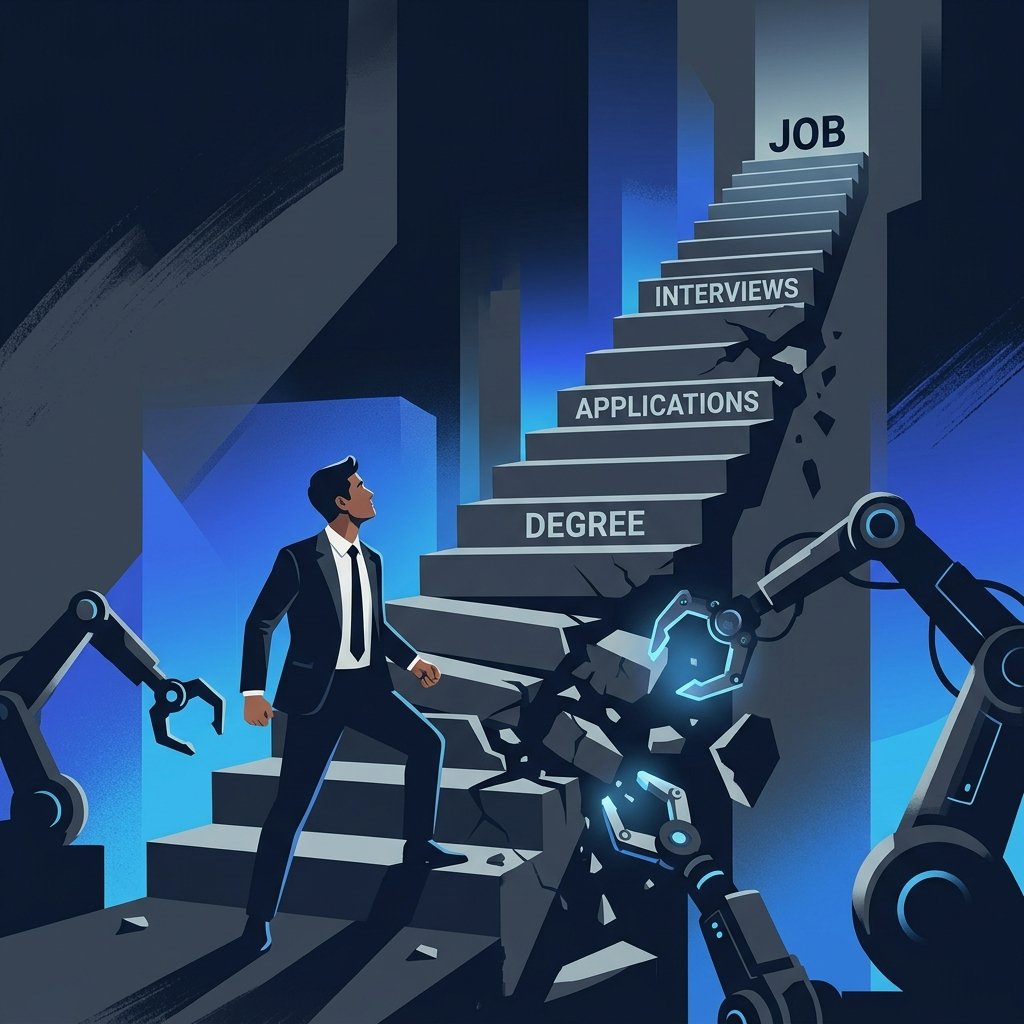
The standard advice given to students for three decades was linear and certain: strong GCSEs lead to good A-levels, a good university opens doors, a degree in a professional field guarantees entry into that field.
That progression is broken.
The accounting and finance degree that once reliably opened doors into professional services now lands graduates in a queue of 188 applicants per role — with a significant portion of those roles not real — competing against 18-year-olds who cost less and AI systems that do the work entirely.
Richard Murphy, economist and academic who has spent years in the accountancy sector, put the problem clearly: employers at universities are aware that graduates are rethinking courses. They are starting programmes and realising mid-degree that the career path the course was designed to enter may not exist by the time they graduate.
Whether to study something you find genuinely interesting over something that appears vocational is a meaningful question when the vocational option no longer carries the guarantee it once did.
The Two-Tier Workforce Taking Shape
The trajectory is visible even if the destination is uncertain.
At the top of the emerging structure: a small group of workers who can orchestrate AI systems, design prompts that extract useful analysis from large models, and manage the outputs of automated workflows with critical judgment. These workers will be in high demand and well compensated.
At the bottom: roles that exist because AI cannot yet handle physical presence, client-facing empathy, or tasks requiring contextual judgment that no training dataset has adequately captured. These roles will be plentiful, low-paid, and precarious.
The middle, where most graduate careers used to begin — data gathering, research, first-draft document production, basic financial analysis — is collapsing. Not slowly. The Big Four hiring data from 2023 to 2024 alone represents thousands of positions that no longer exist.
A marketing company owner described the shift in concrete terms: his firm had entirely rebuilt its service model to write AI prompts for clients doing their own marketing. They had become a tech company. They no longer needed junior staff. And he couldn’t figure out who would eventually replace him when he retired — because nobody had been trained up.
What Graduates Should Actually Do
The data points to one defensible conclusion: AI fluency is not a differentiator. It is table stakes.
A graduate who can demonstrate they understand the difference between using ChatGPT as a search engine and using it as a structured reasoning tool — who can write a detailed, contextual prompt, evaluate the output critically, and integrate it into a professional workflow — is not the same as a graduate who has “used AI.” The distinction matters, and it is visible to anyone who has spent time working with both.
Beyond that: the career path that was supposed to follow the degree is gone for many sectors. The advice to study something that interests you, and build adaptable skills around it, is not defeatist. It is accurate. A graduate who studied history and can research, write, structure arguments, and synthesise information has a more durable skill set than one who studied accounting to access a pipeline that has been cut by 29%.
The job market of 2026 is not friendly to anyone who followed a linear path and expected it to remain passable. It is, however, navigable — for people who understood early that the rules changed and adjusted before the change became obvious.
That adjustment, more than any specific degree or professional qualification, is what will determine outcomes for the generation entering work now.