Index
- Key Takeaways
- The Executive Founders: Dario and Daniela Amodei
- Pre-Training Heavyweights: Karpathy, Kaplan, and Kingma
- The Safety and Alignment Division: Leike and Olah
- Product and Policy Leadership: Krieger and Clark
- Why Anthropic’s Hiring Strategy Defines Its Models
- Frequently Asked Questions
When Anthropic was founded in 2021 by former OpenAI researchers, many industry observers viewed it as a niche research collective focused on AI safety. Today, the organization builds frontier models like Claude Fable 5, manages enterprise integrations across Fortune 500 infrastructure, and operates at a multi-billion dollar compute scale.
Understanding Anthropic requires looking at the specific researchers, engineers, and product leaders steering its strategy. Unlike competitors that emphasize general consumer aggregation, Anthropic has assembled a leadership team combining theoretical physics, foundational deep learning research, consumer product scaling, and empirical alignment science. This guide details who runs Anthropic, their professional backgrounds, public disclosures on X (formerly Twitter), recent recruitments like Andrej Karpathy, and why their specific expertise shapes the company’s trajectory.
Key Takeaways
- The Foundational Schism: Anthropic was founded in 2021 by sibling co-founders Dario and Daniela Amodei alongside five senior OpenAI researchers following disagreements over commercialization timelines and safety governance.
- Andrej Karpathy’s May 2026 Recruitment: The former Tesla AI Director and OpenAI founding scientist announced on X in May 2026 that he joined Anthropic to build a team dedicated to using Claude models to automate pre-training research itself.
- Physics-First Scaling: Chief Science Officer Jared Kaplan authored the foundational 2020 neural network scaling laws, establishing mathematical predictability in language model expansion.
- High-Profile Alignment and Product Recruits: Recent additions include Jan Leike (former OpenAI Superalignment co-lead), Mike Krieger (co-founder of Instagram), and Durk Kingma (co-inventor of the Adam optimizer and VAEs).
The Executive Founders: Dario and Daniela Amodei
The executive control of Anthropic rests with co-founders Dario Amodei and Daniela Amodei, siblings who previously held vice president roles at OpenAI.
Dario Amodei (Co-Founder and Chief Executive Officer)
Dario Amodei earned his undergraduate degree in physics from Caltech and a PhD in biophysics from Princeton University, where his research focused on neural circuit recording. Before co-founding Anthropic, he served as Vice President of Research at OpenAI, overseeing the development of foundational systems including GPT-2 and GPT-3, as well as early Reinforcement Learning from Human Feedback (RLHF) implementation.
Amodei’s physics background heavily influences Anthropic’s engineering philosophy. Rather than relying on heuristic experimentation, his approach treats language model scaling as an empirical physical science governed by mathematical relationships between compute, parameter counts, and data volume.
Daniela Amodei (Co-Founder and President)
Daniela Amodei holds a background in political science and literature from UC Santa Cruz. Before entering technology leadership, she managed international development projects and political campaigns. At Stripe, she worked on risk and customer operations during the payments platform’s early expansion.
Joining OpenAI in 2018, she rose to Vice President of Safety and Operations, managing non-technical safety evaluations, policy teams, and organizational infrastructure. At Anthropic, Daniela Amodei oversees corporate operations, international expansion, organizational structure, and commercial partnerships, balancing technical research execution with institutional administration.
Pre-Training Heavyweights: Karpathy, Kaplan, and Kingma
The technical bedrock of Anthropic’s model capabilities rests on pre-training infrastructure, empirical scaling relationships, and deep learning optimization.
Andrej Karpathy (Technical Staff, Pre-Training Research)
In May 2026, Andrej Karpathy publicly confirmed on X that he had joined Anthropic’s technical staff within the pre-training research group led by Nick Joseph. Karpathy is one of the most recognized computer scientists in artificial intelligence, having served as a founding research scientist at OpenAI, Director of AI and Autopilot Vision at Tesla, and founder of Eureka Labs in 2024.
Upon joining Anthropic, Karpathy placed his work at Eureka Labs on pause to focus on building a specialized research group. His mandate at Anthropic centers on leveraging frontier Claude models to automate and accelerate pre-training research itself. His recruitment represents a strategic effort to establish recursive AI-assisted engineering pipelines, allowing internal model clusters to assist human researchers in discovering optimal pre-training techniques.
Jared Kaplan (Co-Founder and Chief Science Officer)
Jared Kaplan is a theoretical physicist who completed his doctorate at Harvard University and served as a physics professor at Johns Hopkins University. In 2020, while collaborating with OpenAI, Kaplan authored the seminal paper Scaling Laws for Neural Language Models (Kaplan et al., 2020).
This research demonstrated that language model performance scales predictably as a power law against three variables: compute budget, dataset size, and parameter count. At Anthropic, Kaplan oversees core model pre-training, algorithmic architecture, and long-term scaling trajectories, ensuring that compute deployment scales reliably without unexpected performance plateaus.
Durk Kingma (Senior Research Scientist)
Durk Kingma (Diederik P. Kingma) officially announced on X on October 1, 2024, that he was joining Anthropic as a Senior Research Scientist on the core technical staff. A co-founder of OpenAI and former Google DeepMind research scientist, Kingma stated in his announcement that Anthropic’s approach to responsible AI development “resonates significantly” with his own vision.
Kingma is widely recognized in the artificial intelligence community for two foundational technical contributions:
- Variational Autoencoders (VAEs): Co-created with Max Welling, VAEs provided one of the earliest mathematical frameworks for generative deep learning models.
- The Adam Optimizer: Co-authored with Jimmy Ba (Adam: A Method for Stochastic Optimization, 2014), Adam remains the default optimization algorithm used to train modern deep neural networks worldwide.
At Anthropic, Kingma works primarily from the Netherlands on large-scale machine learning, deep learning optimization, and pre-training architectural efficiency.
The Safety and Alignment Division: Leike and Olah
Anthropic was structured around the premise that model capability scaling must be paired with empirical alignment techniques.
Jan Leike (Co-Lead of Alignment Science)
Jan Leike announced on X in May 2024 that he was joining Anthropic to co-lead the Alignment Science team. Leike earned his PhD in computer science from the Australian National University and spent several years as a research scientist at DeepMind focusing on reinforcement learning theory.
At OpenAI, Leike served as Head of Alignment and co-led the Superalignment team alongside OpenAI co-founder Ilya Sutskever. Leike resigned from OpenAI in May 2024, citing public concerns over corporate resource allocation toward safety research versus commercial product launches. At Anthropic, Leike leads research into Scalable Oversight, synthetic feedback alignment (Constitutional AI), and automated evaluation methods to ensure frontier models remain controllable as their reasoning capabilities expand.
Chris Olah (Co-Founder and Mechanistic Interpretability Lead)
Chris Olah is a self-taught computer scientist who previously conducted research at Google Brain and OpenAI, and co-founded the open-access scientific publication Distill.
Olah leads Anthropic’s Mechanistic Interpretability team, a research group dedicated to “opening the black box” of neural networks. Rather than evaluating a model solely by its external text outputs, Olah’s team uses dictionary learning and feature extraction (known as the Circuits framework) to map individual internal neuronal activations. Olah’s team published landmark papers including A Mathematical Framework for Transformer Circuits (2021) and Scaling Monosemanticity: Extracting Interpretable Features from Claude 3 Sonnet (2026), exposing how abstract concepts are represented inside a model’s internal weights.
Product and Policy Leadership: Krieger and Clark
To transition from a pure research enterprise to a commercial organization, Anthropic recruited seasoned executives in product development and public policy.
Mike Krieger (Chief Product Officer)
Mike Krieger joined Anthropic as Chief Product Officer in May 2024. A software engineer and designer educated at Stanford University’s Symbolic Systems program, Krieger is best known as the co-founder and Chief Technology Officer of Instagram, where he built and scaled the system infrastructure from zero to over one billion active users.
Following his tenure at Instagram and Meta, Krieger co-founded Artifact, a personalized news reader acquired by Yahoo in 2024. At Anthropic, Krieger directs product strategy, user experience design, and software interfaces across Claude.ai, the Claude desktop applications, enterprise API integrations, and developer tools like Claude Code and Artifacts. His hiring marked a strategic push to make complex model capabilities accessible via intuitive developer and enterprise environments.
Jack Clark (Co-Founder and Head of Policy)
Jack Clark previously served as a technology journalist for Bloomberg and The Register before transitioning into AI governance as OpenAI’s Policy Director. He also co-chairs the Stanford University AI Index, an annual report tracking worldwide AI development indicators.
At Anthropic, Clark leads public policy, international regulatory engagement, and risk governance. He was instrumental in drafting Anthropic’s Responsible Scaling Policy (RSP), a self-regulatory commitment that defines clear safety levels (ASL-1 through ASL-4) and requires specific technical containment measures before training higher-capability models.
Why Anthropic’s Hiring Strategy Defines Its Models
Evaluating Anthropic’s organizational structure highlights a deliberate executive recruitment strategy:
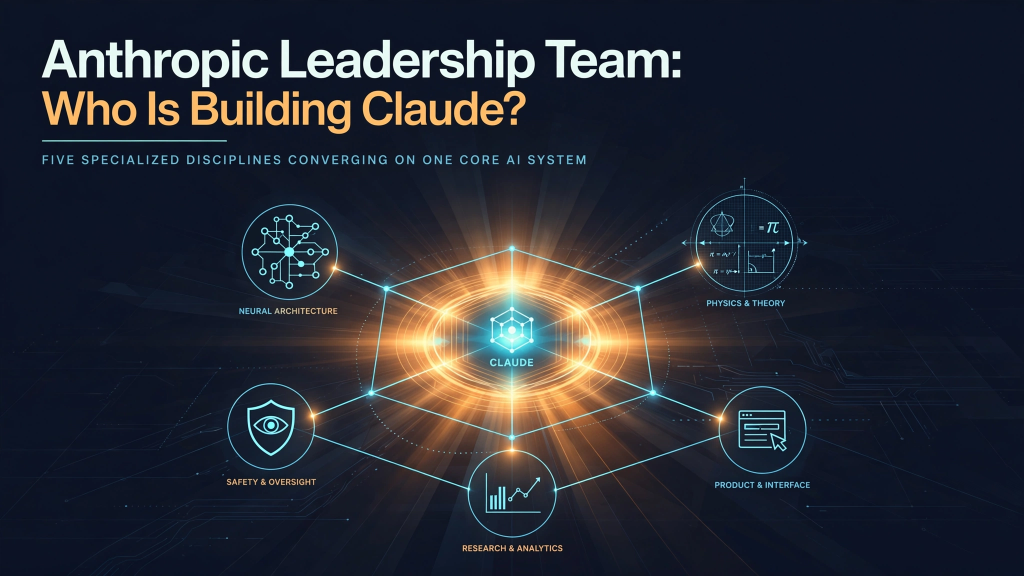
| Leadership Division | Key Leaders | Strategic Responsibility |
|---|---|---|
| Executive Leadership | Dario Amodei (CEO) Daniela Amodei (President) | Corporate strategy, compute allocation, PBC governance & institutional oversight |
| Pre-Training & Compute Scaling | Andrej Karpathy Jared Kaplan (CSO) Durk Kingma | Empirical scaling laws, automated AI-assisted pre-training, algorithm optimization (Adam, VAEs) |
| Safety & Empirical Alignment | Jan Leike Chris Olah | Scalable oversight, Constitutional AI, mechanistic interpretability (Circuits, feature extraction) |
| Product & Policy Steering | Mike Krieger (CPO) Jack Clark | Enterprise UI/UX (Claude Code, Artifacts, Cowork), Responsible Scaling Policy (RSP) governance |
- Mathematical Predictability over Unbounded Guesswork: Hiring theoretical physicists like Jared Kaplan ensured that compute investment is governed by scaling laws rather than ad-hoc trial and error.
- AI-Assisted Research Acceleration: Recruiting Andrej Karpathy in May 2026 introduced dedicated effort toward using Claude models to automate pre-training experimentation.
- Explicit Separation of Alignment and Capability: Recruiting safety pioneers like Jan Leike and Chris Olah established dedicated internal teams focused on interpretability and oversight, operating alongside core pre-training engineers.
- Consumer Product Execution: Bringing in consumer tech veterans like Mike Krieger provided the engineering discipline required to turn raw model checkpoints into widely adopted software tools.
Frequently Asked Questions
When did Andrej Karpathy join Anthropic and what is his role?
Andrej Karpathy joined Anthropic in May 2026 as part of the technical staff in the pre-training research group. His focus is on building an internal team dedicated to using Claude models to accelerate pre-training research and engineering workflows.
Why did the founders leave OpenAI to create Anthropic in 2021?
Dario Amodei, Daniela Amodei, and five senior researchers left OpenAI in late 2020 following internal disagreements over the organization’s corporate structure, rapid commercialization timelines, and the prioritization of safety research relative to commercial model launches.
Who controls the governance of Anthropic?
Anthropic operates as a Public Benefit Corporation (PBC). While it has raised multi-billion dollar strategic investments from Amazon and Google, executive control rests with the board of directors and corporate leadership, governed by a Long-Term Benefit Trust designed to ensure safety commitments take precedence over short-term financial returns.
What is the relationship between scaling laws and Anthropic’s compute investments?
Scaling laws (established by Chief Science Officer Jared Kaplan) provide mathematical formulas that predict how language model performance improves as compute and dataset size increase. This allows Anthropic to forecast model performance prior to committing multi-hundred-million-dollar training clusters.
About the Author
Ether Exter is an AI enthusiast with 5 years of experience testing and experimenting with AI models, breaking down what actually works. Follow on X: @EtherExperiment.
Sources
- Anthropic Company Structure & Executive Team Roster, Anthropic Corporate, 2026. Anthropic Leadership.
- Karpathy, Andrej. Public Statements on Joining Anthropic Pre-Training Group, X (formerly Twitter), May 2026.
- Leike, Jan. Transition Announcement and Alignment Strategy, X (formerly Twitter), May 2024.
- Kingma, Diederik P. Joining Anthropic Announcement, X (formerly Twitter), October 1, 2024.
- Kaplan, Jared, et al. “Scaling Laws for Neural Language Models,” arXiv:2001.08361, 2020.
- Olah, Chris, et al. “Transformer Circuits Thread & Mechanistic Interpretability Research,” Distill, 2024.