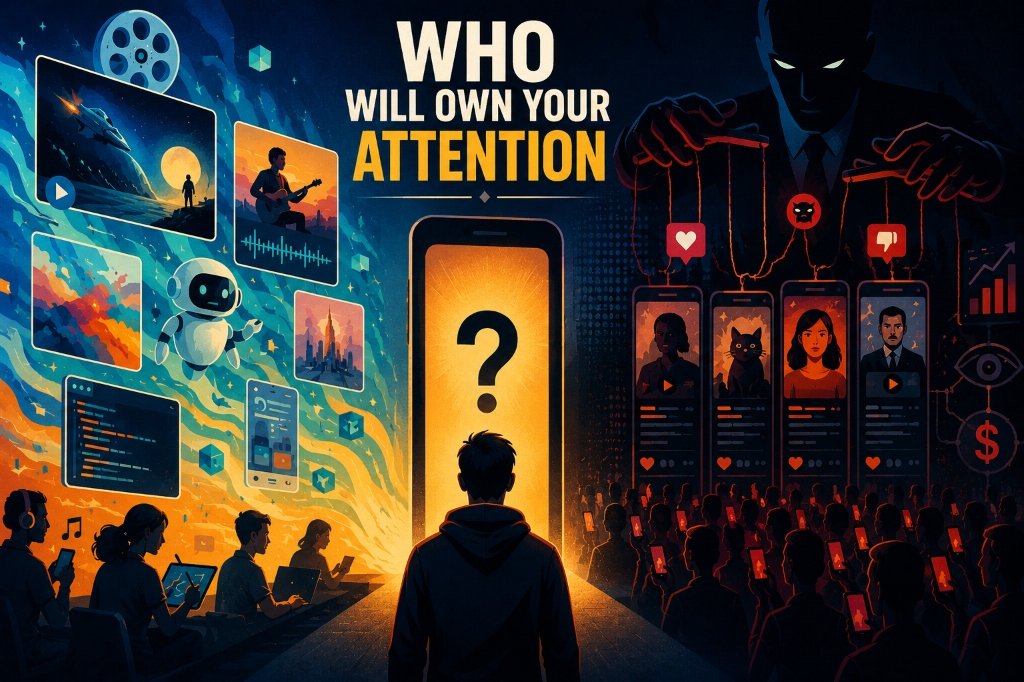
A teenager in a small town types a sentence into a prompt box. Forty-five seconds later, she has a finished stereo track with professional vocals, studio production, and a hook that belongs on a streaming chart. She did not play an instrument. She did not spend years learning sound engineering. She described what she felt, and the model generated the music.
She does not post it on YouTube. She does not need an algorithm to find her an audience. She created it for herself.
Nobody in Silicon Valley planned for that.
In this piece: Why does the $930 billion advertising empire built on your boredom depend on something AI just made free? What are the platforms actually afraid of? And who controls your attention when you no longer need to consume what someone else made?
What They Were Actually Selling
On the surface, everything looks fine. Alphabet reported $119.8 billion in quarterly revenue, Meta’s ad income crossed $55 billion, and YouTube cleared $11.06 billion. Mark Zuckerberg told investors his AI models now understand user intent, driving a 10% lift in Reels watch time while Sundar Pichai claimed AI features are redefining every part of Google’s business.
The obvious story is that platforms are winning and AI is their ultimate weapon. Except 68% of Google searches now end without a single click to an external website.
To understand why those record earnings are misleading, you have to look at what the platforms actually sell.
They do not sell content. They sell your time.
Every infinite scroll, every autoplay feature, every recommendation algorithm exists for one purpose: keeping you inside the platform long enough for an ad to reach you. TikTok extracts roughly 95 minutes per day from each daily user — before most people have had a real conversation, answered a work email, or spent time with anyone they actually know. YouTube takes 75 minutes. Instagram takes 55 minutes. The average person globally hands over two and a half hours of their day to social feeds. That is more time than they spend cooking, exercising, or talking to their families.
Advertisers pay for that time. In 2026, global digital ad spend is approaching $930 billion, according to eMarketer and GroupM data. Seventy percent of every advertising dollar on Earth flows directly to digital platforms. The math is straightforward: more minutes of user attention equals more revenue from brands selling products.
The entire system runs on one foundational premise: creating content has to be hard.
If making a song is hard, you listen to Spotify. If making a video is hard, you watch YouTube. If writing an article is hard, you scroll through a feed of articles written by others. The platforms exist because most people cannot manufacture the entertainment or answers they want to consume. Users consume what others created, and the platforms collect the toll at the gate.
That premise just expired.
The Feed Was a Workaround
Sam Altman, the CEO of OpenAI, described where this shift leads. “95% of what marketers use agencies, strategists, and creative professionals for today,” he wrote, “will easily, nearly instantly and at almost no cost be handled by the AI. Images, videos, campaign ideas? No problem.”
He was describing a market where the feed becomes optional.
Think about why people actually scroll through social feeds. Someone else did the work of finding and making something worth watching, and the viewer only had to show up. The feed was a historical workaround for not having the tools to generate your own tailored experience.
Generative tools like Suno produce full 3-minute stereo tracks in under 60 seconds. AI video systems generate cinematic footage from plain text descriptions. Solo developers build complete full-stack applications in an afternoon using tools that previously required entire engineering departments, accelerating the vibe coding movement. Studies from Neil Patel Digital show the average AI-assisted article takes 16 minutes to produce, compared to 69 minutes for a human writing manually.
When creating a personalized experience costs the same effort as consuming someone else’s, a portion of users will choose to create. Every person who makes that choice is a user spending less time inside the algorithmic feed.
The platforms are not afraid of a competing social network. TikTok tried that and failed to displace Meta’s core dominance. What they are actually afraid of is the fundamental question AI raises about whether the feed needs to exist at all.
The Crack Before the Collapse
Google’s search business reveals the crack before the larger collapse.
Data from SparkToro and Similarweb shows 68.01% of Google searches this year end without a user clicking a single link — up from 60.45% two years ago. For every 1,000 searches, only 276 clicks reach the open web, down from 374 in 2024. Behind that 26% drop in two years are digital publishers who built their revenue on search traffic, writers paid per click, and businesses whose primary marketing channel was organic ranking. When Google’s AI Overviews appear on a results page, organic click-through rates fall by roughly 60%. The AI answering the query is owned by the same company that sold the search ad beside it.
Google built an AI system so effective at synthesizing answers that users stop visiting the websites those answers originally came from. The company is cannibalizing the open web ecosystem that makes its search advertising valuable.
ChatGPT crossed 1 billion monthly active users by May 2026, while Gemini reached 950 million users. These conversational tools do not compete for attention by keeping users scrolling. They answer queries directly and release the user. A person receiving an instant answer in three seconds sees fewer ads than someone browsing web pages for 75 minutes. That user’s attention redirected to interfaces platforms are not currently equipped to monetize.
Record quarterly revenue is a lagging financial indicator. User behavior shifts before corporate earnings reflect the movement. The behavioral shift has already begun.
Two Things Are True at Once
Two conflicting forces are operating across the technology industry simultaneously.
The first force: tech monopolies are adapting aggressively. Google processes 22 billion AI tokens per minute through Gemini Flash models. Meta is spending tens of billions on custom AI chips and infrastructure. Every major platform uses generative models to tighten the recommendation feed — making the algorithm so precise that leaving the platform feels difficult. Zuckerberg’s AI models do not give users tools to build; they make the feed feel personalized enough that users forget to look elsewhere.
The analyst Ben Thompson has a term for this strategy: a sustaining innovation. A sustaining innovation uses a disruptive technology to strengthen an existing business model rather than asking whether the model should exist. The distinction matters. A sustaining innovation improves the trap. A disruptive innovation makes the trap unnecessary. Every major platform is deploying sustaining AI while avoiding disruptive alternatives.
The second force: corporate adaptation cannot fix a broken structural premise. The feed was built on content scarcity. AI creates instant abundance. You cannot make content creation scarce again. You cannot un-invent Suno, Runway, or the generative tools that allow a teenager in a small town to render a high-production track in seconds. The premise supporting the feed is gone.
Ben Thompson’s Aggregation Theory — the framework explaining how Google and Meta built their monopolies by controlling user demand when content supply became infinite — assumed that producing content remained difficult. That was true when the theory was written. Blogs required effort. Videos required equipment. Music required technical training. The aggregator sat in the middle because users could only consume. When creation costs approach zero, the middleman loses its structural necessity. AI connects human intent directly to finished output.
What AI Cannot Copy
Digital platforms retain one core asset that generative AI cannot replicate.
Other real human beings.
Not synthetic media. Other humans — their choices, their live reactions, their actual lives shared publicly with an audience. When a creator records a genuine response to an event, viewers are not paying attention to production quality. They are connecting with the person on the screen.
That human connection is not something a generative model can simulate with synthetic video. The creator’s authenticity is the product, and authenticity cannot be generated by token prediction.
The platforms that survive this shift will be those that realize they were never primarily in the content delivery business. They were in the human-presence business. Every content category an algorithm can replicate — templated reaction videos, SEO-optimized listicles, engagement bait following standard formulas — will be automated. What remains scarce is a real person’s decision to share their actual experience.
The attention economy is sorting itself into two tiers. Content created for a generic median audience is being commoditized by AI models. Content that is valuable specifically because it originated from one human at one distinct moment will become more valuable over time.
The question is whether platform executives understand that distinction, or whether they remain focused on optimizing ad impressions on a decaying feed while enterprise AI spending caps reallocate capital across tech.
The Questions Nobody Has Answered
Two critical questions remain unresolved by current industry data.
First: will human society maintain a demand for shared culture? AI personalizes output for the individual, but culture relies on shared references. A broadcast event works because tens of millions of people observe the exact same moment simultaneously. An AI video generated for one person is highly relevant but culturally isolated. If every user generates custom entertainment, common cultural touchstones evaporate. Whether that isolation creates a longing that draws users back to shared feeds remains unmeasured.
Second: where does the $930 billion in global ad spend migrate? Capital follows human attention. If platform session lengths decline, advertising dollars will flow toward AI conversational interfaces, automated commerce agents, and cloud AI coding agents managing user tasks. The budget will not disappear, but it will pass through infrastructure that legacy ad networks do not control.
Two Ways This Ends
If platforms deploy sustaining AI quickly enough to make feeds endlessly engaging, incumbents will absorb another technological wave. Their capital, user data, and infrastructure will preserve their monopolies.
If the shift from passive consumption to active generation reaches a tipping point where users prefer creating their own experiences, current quarterly profits represent the peak of an old model. The corporate structure looks secure until the underlying user habit breaks.
Current evidence supports both trajectories. Quarterly earnings support the first reading. The 68% zero-click search rate, 1 billion ChatGPT users, and individual creators generating media independently support the second.
The second trajectory represents the structural reality. Record revenue is what corporate filings report. Where individuals direct their attention during their first waking hour is what determines the market. Those two signals are beginning to diverge.
Frequently Asked Questions
Will AI replace social media platforms?
AI will not replace the social graph — it cannot replicate the reality that a friend or family member posted an update. However, AI is replacing the time users spend on feeds for idle discovery, entertainment, and information gathering. Those three activities represent the majority of daily social media usage.
If AI generates infinite content, won’t platforms be needed to curate it?
Curation changes fundamentally when content is synthetic. Platforms currently organize content created by humans. If the majority of media becomes AI-generated, platforms become aggregators of synthetic output, which carries lower perceived value. Value shifts toward authenticating human identity and verified human creation.
What does this shift mean for content creators?
Creators who built an audience around their personal identity and authentic perspective will retain value. Creators whose primary output was producing generic, commodity content efficiently will find AI models performing the same work at near-zero marginal cost.
The platforms spent two decades perfecting the mechanics of capturing human attention. The teenager generating a song in her bedroom never asked for a platform. She had something to express, and a tool that rendered it immediately.
About the Author
Ether Exter is an AI enthusiast with 5 years of experience testing and experimenting with AI models, breaking down what actually works. Follow on X: @EtherExperiment.