Verified as of July 10, 2026. This analysis is updated quarterly to track European compute infrastructure deployments, Mistral model releases, and corporate partnerships.
- The US-China Monopoly and Europe’s Third Way
- ‘Fat but Sparse’: The Next-Generation Open-Weight Model
- Physical AI: Robostral Navigate and Simulation Limitations
- The Industrial Focus: Physics-AI and Pre-Existing Partnerships
- Sovereign Compute: Funding and Infrastructure Expansion
- FAQ
- Sources
Key Takeaways
- The Strategy: Rather than racing for top benchmark scores, Mistral AI is focusing on open weights, data sovereignty, and industrial partnerships to establish a distinct European path.
- The New Model: In early July 2026, Mistral opened early access to a new “fat but sparse” Mixture-of-Experts model, designed to deliver high capacity with low inference costs.
- Physical AI: Mistral launched Robostral Navigate, an 8B hardware-agnostic robotics model that uses a single RGB camera for autonomous navigation, though real-world testing remains unverified.
- The Funding: Alongside its server expansion, Mistral is reportedly in talks to raise €3 billion at a valuation near €20 billion, demonstrating deep financial backing for its sovereignty thesis.
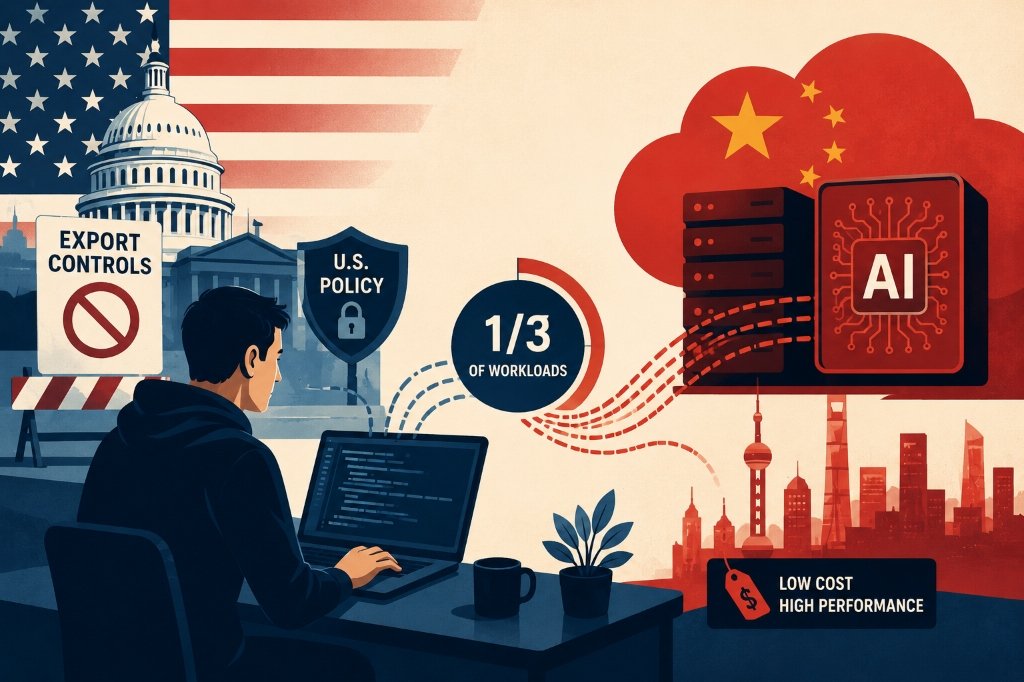
The global artificial intelligence market has largely been defined by a two-sided race between the United States and China. As U.S. providers push premium tiers into expensive paid credits, such as the recent Claude Fable 5 credits-only pricing shift, and American developers adopting Chinese AI models to save costs, Europe is taking a different route.
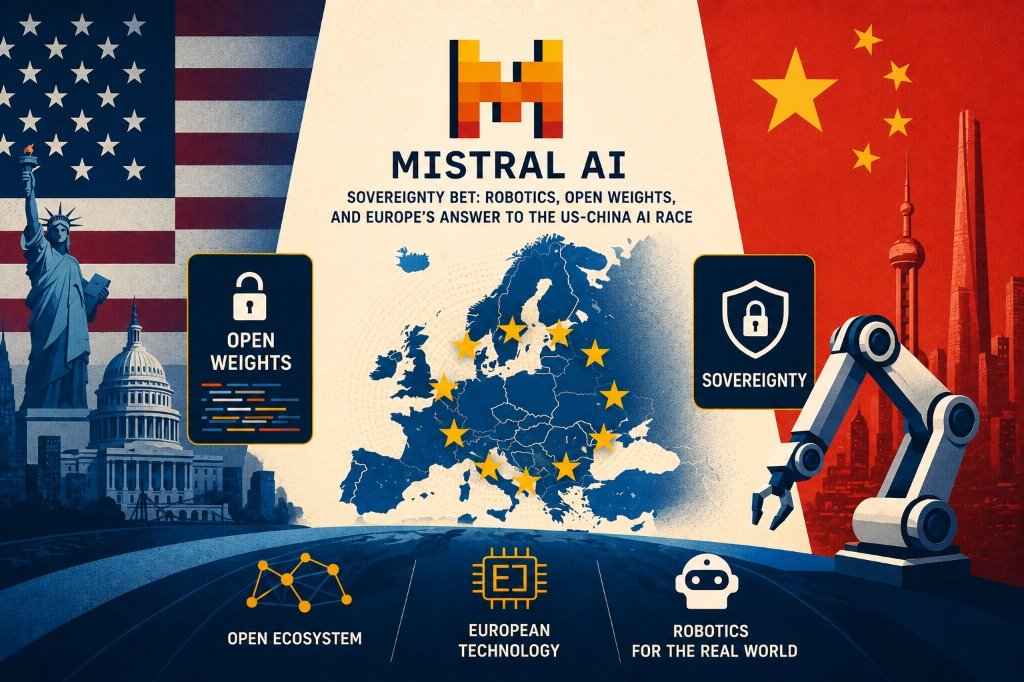
Instead of competing in a raw benchmark race, France-based Mistral AI is betting on a third way: strategic independence, open weights, and industrial data sovereignty.
‘Fat but Sparse’: The Next-Generation Open-Weight Model
In early July 2026, Mistral opened early access to government, research, and industry partners for a new Mixture-of-Experts (MoE) model. Described by CEO Arthur Mensch as “fat but sparse,” the architecture features a large total parameter count to provide a high quality ceiling, while activating only a small subset of parameters (the “experts”) for any single query. This approach yields high-capacity outputs while keeping inference costs and compute requirements low.
Importantly, Mistral is maintaining its committed open-weight strategy. The new model will be downloadable, allowing enterprises to inspect and run the weights on their own hardware. This strategy aligns with Mensch’s refreshingly honest positioning of the company. Mensch has openly stated that Mistral’s current flagship, Mistral Large 3, does not lead on raw capability benchmarks.
Instead of chasing marginal benchmark gains, Mistral focuses on providing highly capable, transparent models that businesses can control locally, mitigating the risk of vendor lock-in and unexpected API pricing changes.
Physical AI: Robostral Navigate and Simulation Limitations
Mistral is also expanding beyond text-based chatbots into the physical world. On July 8, 2026, the company launched Robostral Navigate, an 8B parameter robotics model designed for autonomous physical navigation.
Robostral Navigate is hardware-agnostic and trained entirely in simulation. Unlike traditional robotics setups that rely on complex multi-sensor arrays, the model allows robots to navigate physical spaces using language prompts and a single, monocular RGB camera. In benchmarks on the unlearned R2R-CE dataset, the model achieved a 76.6% success rate, demonstrating the viability of monocular depth perception for robotic routing.
However, the model has met with notable skepticism from roboticists and software engineers. Critics point out that the 76.6% success rate was achieved entirely within a simulation environment, with no documented real-world physical deployment results. Furthermore, these claims come directly from Mistral’s own self-reported documentation rather than independent peer review. Transitioning from simulation to physical reality remains one of the hardest challenges in robotics, leaving the model’s actual utility in diverse physical environments unverified.
The Industrial Focus: Physics-AI and Pre-Existing Partnerships
At the AI Now Summit in Paris, Mistral articulated its broader physics-AI stack and vision. This stack leverages Mistral’s acquisition of physics-AI specialist Emmi AI to accelerate engineering, design, and manufacturing processes like semiconductor fabrication.
However, it is important to note that these agreements did not drop simultaneously. The partnerships with Airbus and BMW Group were already in motion since May, established during the Emmi acquisition period. Rather than a single unified announcement, the summit served to consolidate these pre-existing industrial relationships into a cohesive sovereign technology initiative with ASML, Airbus, and BMW.
Crucially, the partnership is positioned around data sovereignty. By deploying Mistral’s open-weight models within their own secured systems, these industrial giants avoid routing sensitive corporate intellectual property and engineering data through U.S. commercial cloud providers.
Sovereign Compute: Funding and Infrastructure Expansion
To mitigate compute supply chain risk and ensure infrastructure independence, Mistral is expanding its physical server footprint. This expansion is funded by a massive investment program and includes:
- Swedish Hydropower: Mistral is deploying compute capacity in Sweden, utilizing hydropower-backed facilities to ensure sustainable, low-carbon training and inference.
- French Inference Hub: A new 10MW inference-focused data center is opening in Les Ulis, France, targeted for operational status in Q3 2026.
This infrastructure push is gaining substantial financial backing. Reportedly, Mistral is in talks to raise approximately €3 billion at a valuation near €20 billion, nearly doubling its prior valuation. This massive scale of funding supports the thesis that European tech sovereignty is winning real backing, allowing Mistral to build capital-intensive server capacity.
Macron personally endorsed the initiative alongside Arthur Mensch and Nvidia’s Jensen Huang, calling Mistral’s cloud initiative “historic.” This government-level alignment highlights how closely Mistral’s success is tied to Europe’s broader geopolitical goal of tech sovereignty.
FAQ
What is Mistral’s “fat but sparse” model?
It is a Mixture-of-Experts (MoE) model in early access that has a high total parameter capacity (fat) but only activates a fraction of those parameters per query (sparse), maintaining low inference costs.
What is Robostral Navigate?
Robostral Navigate is an 8B parameter robotics model released on July 8, 2026. It allows robots to navigate environments using language prompts and a single RGB camera.
Who are Mistral’s major industrial partners?
Mistral has partnered with Airbus, BMW Group, and ASML to deploy sovereign, physics-based AI models within their design and manufacturing workflows.
Why is data sovereignty important for these partners?
By running open-weight models locally, industrial companies keep sensitive IP and engineering data on their own infrastructure, avoiding U.S. or Chinese cloud dependencies.
Sources
- Mistral AI Platform Announcements: Mistral AI Newsroom
- Industrial Partnership Details: Futurum Group Analysis
- Infrastructure and Data Centers: Maddyness Tech Journal
- Developer Community Tracking: Hacker News AI Threads
About the Author
Ether Exter is an AI enthusiast with 5 years of experience testing and experimenting with AI models, breaking down what actually works. Follow on X: @EtherExperiment.