Verified as of July 9, 2026. This analysis is updated quarterly to monitor US regulatory shifts, import policies, and global model API usage data.
- The Contradiction: Washington Bans versus Developer Adoption
- Why Developers Are Shifting: Cost and Performance Parity
- Ecosystem Context: Rising API Costs and ‘Tokenmaxxing’
- Case Study: Lindy’s Complete Migration to DeepSeek
- The Policy Debate: Do Export Controls Work?
- FAQ
- Sources
Key Takeaways
- The Trend: Data from AI routing platform OpenRouter shows that Chinese-origin AI models account for at least 30% of enterprise token volume weekly, peaking at 46% this year.
- The Comparison: This is a dramatic increase from an 11% average in the prior year and just 4.5% in the first half of 2025.
- The Motivation: Chinese open-source and open-weight models from providers like DeepSeek and Z.ai are 60% to 90% cheaper than American alternatives while offering highly competitive performance.
- The Paradox: While US policy focuses on restricting Chinese AI access and limiting local deployment, American developers are voluntarily routing significant workloads to Chinese models.
The United States government has taken a highly restrictive stance toward artificial intelligence development, implementing strict controls on foreign access and limiting domestic use to pre-approved systems. This regulatory push was detailed in the analysis of how the US government bans AI models.
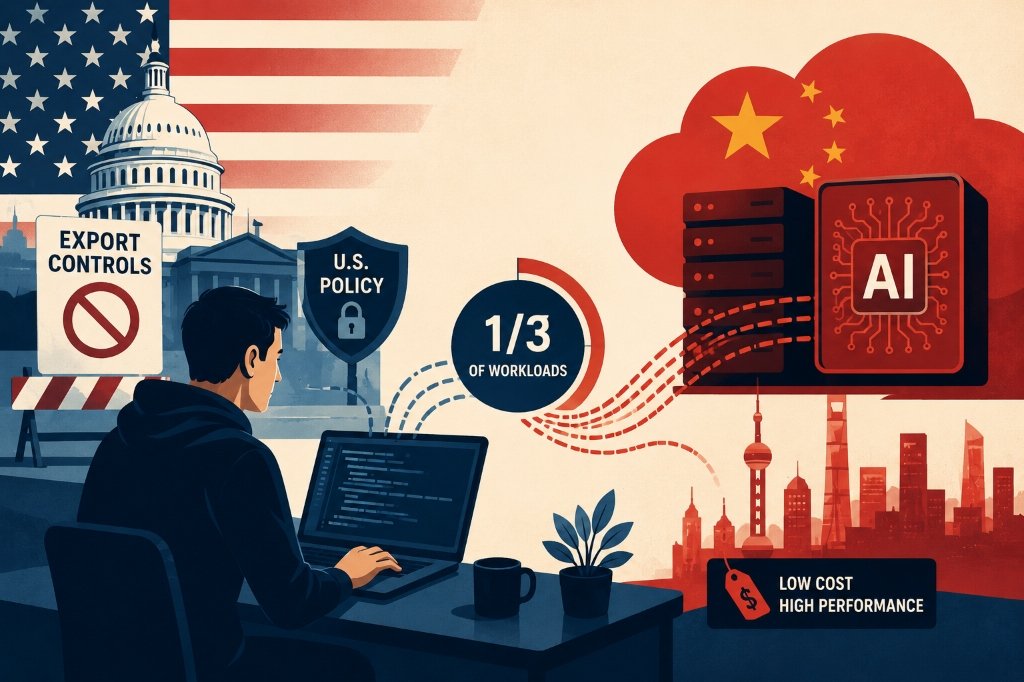
However, a stark gap has emerged between federal policy and actual developer behavior. While Washington works to isolate Chinese AI systems, American developers are quietly routing a massive share of their workloads to them.
The Contradiction: Washington Bans versus Developer Adoption
Data from OpenRouter, a popular platform that allows developers to route queries to various large language models, reveals a significant market shift. Since February 8, 2026, Chinese-origin AI models have accounted for at least 30% of weekly enterprise token volume on the platform, reaching a peak of 46%.
To understand the speed of this transition, consider the historical context:
- First Half of 2025: Chinese models held just a 4.5% share of weekly token volume.
- Prior Year Average: The average share sat at 11%.
- Current Baseline: Weekly usage has stabilized at over 30%.
This data indicates that despite federal warnings and the threat of upcoming trade restrictions, the market is choosing its tools based on practicality rather than political alignment.
Why Developers Are Shifting: Cost and Performance Parity
This transition is driven by cost efficiency and performance, not ideology. High-volume enterprise workloads, especially in software engineering and automated agent deployment, require millions of tokens daily.
According to OpenRouter data, open-source and open-weight Chinese models are priced 60% to 90% cheaper than comparable models from U.S. frontier labs. At the same time, the capability gap between U.S. and Chinese systems has shrunk dramatically. Kyle Chan, a researcher at the Brookings Institution, points out that the current capability gap between U.S. and Chinese models is now only six to nine months, making the performance difference negligible for most commercial operations.
Because of this performance parity, software engineering teams are choosing pragmatism over brand loyalty. As Harpreet Arora, head of AI at Vercel, observed:
“Price is doing the work here. Teams are beginning to route it to the cheapest one that’s good enough.”
This budget-focused optimization is especially popular among engineers practicing vibe coding, where rapid prototyping and high-volume token generation make raw API costs a critical bottleneck.
Ecosystem Context: Rising API Costs and ‘Tokenmaxxing’
This shift to cheaper models comes as U.S. providers increase costs for premium tiers. A prime example is the recent Claude Fable 5 credits-only pricing shift, which ended flat-rate subscription access for Anthropic’s top-performing model and forced developers to pay twice the rate of previous flagships.
This trend has drawn sharp criticism from business leaders. On July 1, 2026, Palantir CEO Alex Karp publicly called the token-based pricing model “fundamentally broken” and likened it to a “wealth tax” that forces companies to pay for tokens that fail to create value. Karp warned against “tokenmaxxing,” a practice where AI providers focus on maximizing token throughput to increase their own revenues rather than optimizing efficiency for the client.
Faced with these cost structures, enterprise teams are opting out of expensive U.S. commercial clouds in favor of cheaper open-weight alternatives.
Case Study: Lindy’s Complete Migration to DeepSeek
The migration of enterprise workloads is not hypothetical; it is happening at scale. One notable example is Lindy, a startup building automated AI employees.
Lindy recently migrated 100% of its production traffic from Anthropic’s Claude models to the Chinese open-weight model DeepSeek. According to Lindy CEO Flo Crivello, the complete switch to DeepSeek will save the company millions of dollars annually in operational costs while maintaining equivalent output quality for their users.
This corporate migration highlights the core contradiction of current tech policy: while the U.S. government works to block Chinese models, American startups are depending on them to stay financially viable.
The Policy Debate: Do Export Controls Work?
This developer trend raises significant questions about the effectiveness of Washington’s export-control strategy. If the primary goal of restricting AI technology is to protect domestic industries and maintain a technological lead, the voluntary routing of workloads to foreign models suggests that developers are finding ways to bypass these boundaries.
Supporters of strict controls argue that relying on foreign AI infrastructure introduces security risks, particularly concerning data retention and privacy. Conversely, industry advocates suggest that restricting access to competitive, low-cost models could harm American startups by forcing them to pay higher operational costs than their international competitors.
This tension creates an open policy debate: can national security goals be achieved if market forces actively incentivize developers to look elsewhere?
FAQ
Why are US developers using Chinese AI models?
Developers use Chinese models because they are 60% to 90% cheaper than U.S. alternatives while offering competitive performance on coding and logic tasks.
Which Chinese models are most popular?
Models from DeepSeek and Z.ai (such as the GLM series) are widely used for enterprise token routing on platforms like OpenRouter.
Are there security risks in using these models?
Yes. Many Chinese API providers do not offer the same zero-data-retention guarantees as U.S. enterprise options, raising privacy concerns for proprietary data.
How does this affect US AI policy?
The trend highlights a conflict between national security policies designed to restrict Chinese AI and the financial realities of startups that rely on cheap API access.
Sources
- CNBC Reporting on Model Adoption: CNBC Business News
- OpenRouter Usage Data: OpenRouter API Statistics
- Palantir CEO Alex Karp CNBC Interview: CNBC Squawk Box
- US Department of Commerce Export Controls: Bureau of Industry and Security
About the Author
Ether Exter is an AI enthusiast with 5 years of experience testing and experimenting with AI models, breaking down what actually works. Follow on X: @EtherExperiment.