Index
- Key Takeaways
- The Establishment of WAICO in Shanghai
- The Founding Nations: Confirmed Signatories vs. Reported Roster
- Pledges, Capacity Building, and Infrastructure Access
- Strategic Context: A Parallel Order to Western AI Governance
- Counter-Arguments and Governance Challenges
- Frequently Asked Questions
- Sources and References
Key Takeaways
- The Announcement: On July 16, 2026, ahead of the World Artificial Intelligence Conference (WAIC) in Shanghai, 29 founding countries signed an agreement establishing the World Artificial Intelligence Cooperation Organization (WAICO).
- Headquarters and Structure: WAICO is headquartered in Shanghai as an independent intergovernmental international organization, designed to offer an alternative framework to Western-led AI regulation bodies.
- Signatory Status: Official Chinese Foreign Ministry releases have publicly named 11 key member states (including China, Russia, Brazil, Indonesia, Kazakhstan, Laos, Pakistan, Serbia, South Africa, Ethiopia, and Cambodia). The complete 29-country official signatory document has not been published in a single state release.
- Core Commitments: China pledged 5,000 AI training slots for developing nations over 5 years and announced joint AI application cooperation centers spanning ASEAN, the African Union, BRICS, and the Shanghai Cooperation Organization (SCO).
- Regulatory Positioning: WAICO explicitly rejects the practice of overstretching national security concepts to restrict technological exports, positioning itself as a sovereign-focused, open-weight-friendly governance model.
The Establishment of WAICO in Shanghai
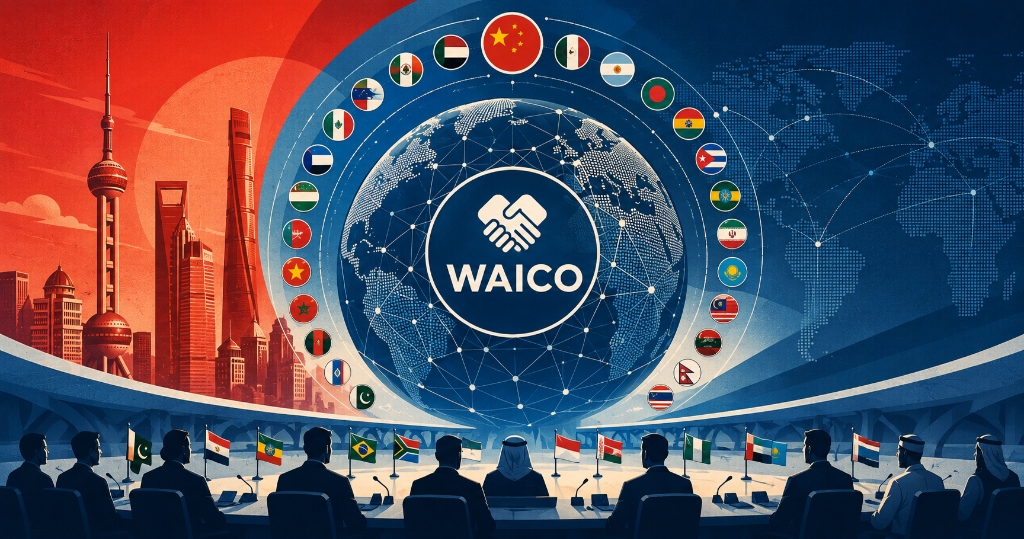
On July 16, 2026, on the eve of the annual World Artificial Intelligence Conference (WAIC) in Shanghai, representatives from 29 nations convened to formally sign the founding charter of the World Artificial Intelligence Cooperation Organization (WAICO).
Chinese Foreign Minister Wang Yi signed the accord on behalf of China, with United Nations Secretary-General António Guterres attending the ceremony. In a keynote address delivered during the conference, President Xi Jinping outlined WAICO’s core mission: creating a multilateral system for global AI governance centered on state sovereignty, shared technological benefits, and equal access for developing economies.
| Governance Dimension | Western Frameworks (US / EU / G7) | WAICO Framework (China / Global South) |
|---|---|---|
| Core Priority | Frontier risk mitigation & strict audits | State sovereignty & open technological access |
| Regulatory Model | Binding compute thresholds & export controls | Opposition to trade barriers & security overstretch |
| Model Access | Proprietary APIs & licensed enterprise models | Open-weight model sharing & local fine-tuning |
| Developing World Focus | Voluntary compliance & safety summits | 5,000 training slots & regional application centers |
The establishment of WAICO follows China’s initial proposal introduced at the 2025 WAIC and reiterated at the 33rd APEC Economic Leaders’ Meeting. Headquartered permanently in Shanghai, WAICO operates as an independent intergovernmental organization. Its charter emphasizes that global AI rules should be drafted through broad international consensus under United Nations principles, rather than set unilaterally by a small alliance of tech-exporting Western states.
The Founding Nations: Confirmed Signatories vs. Reported Roster
While Chinese state news agency Xinhua confirmed that representatives from 29 countries participated in the Shanghai signing ceremony, Beijing’s official Ministry of Foreign Affairs communiqués have explicitly highlighted 11 primary member states. A single, comprehensive 29-nation signatory list has not been published in an official government release.
The table below distinguishes between member nations explicitly named in Chinese state communiqués and those identified through secondary diplomatic reporting:
| Region | Confirmed in Official Releases | Reported / Secondary Sources | Key Regional & Economic Context |
|---|---|---|---|
| East & Southeast Asia | China, Cambodia, Indonesia, Laos | Malaysia, Myanmar | Digital infrastructure hubs, semiconductor packaging, open-weight model deployment |
| Central & South Asia | Kazakhstan, Pakistan | Kyrgyzstan, Tajikistan, Uzbekistan | Belt and Road transit corridors, energy infrastructure, regional trade groups |
| Africa | Ethiopia, South Africa | Algeria, Cameroon, Congo, Kenya, Lesotho, Mozambique, Senegal, Zambia | Growing software developer ecosystems, mineral resources, telecommunications networks |
| Latin America & Caribbean | Brazil | Cuba, Nicaragua, Venezuela | BRICS trade connections, agricultural supply chains, non-aligned foreign policy |
| Eastern Europe & Eurasia | Russia, Serbia | Belarus | Energy exports, engineering pools, non-Western security and trade partnerships |
| Middle East | — | Oman | Strategic maritime corridors and sovereign wealth capital |
Notably, the founding roster excludes G7 members, European Union nations, the United Kingdom, Japan, and South Korea. By focusing on emerging markets across Asia, Africa, and Latin America, WAICO seeks to build a voting bloc in global technology standardization bodies.
Pledges, Capacity Building, and Infrastructure Access
To incentivize participation among developing nations, China announced several concrete initiatives attached to WAICO’s launch:
- Technical Training: Provision of 5,000 AI technical training slots and seminars over the next five years specifically tailored for researchers and policymakers from member countries.
- Regional Cooperation Centers: The establishment of joint AI application cooperation centers aligned with existing multilateral groupings, including ASEAN, the African Union, the League of Arab States, CELAC, BRICS, and the Shanghai Cooperation Organization (SCO).
- Open-Weight Sharing: Commitments to facilitate low-friction sharing of open-weight model architectures and dataset resources, allowing participating nations to build localized domain applications without depending on licensed Western API endpoints.
This focus on infrastructure and knowledge transfer contrasts with Western regulatory discussions, which often center on frontier risk audits, red-teaming requirements, and strict compute tracking. For many developing nations facing high compute costs and energy constraints, access to open models and technical training presents an immediate practical incentive.
Strategic Context: A Parallel Order to Western AI Governance
The launch of WAICO represents a major turn in international tech policy. Over the past three years, the global governance discussion was largely shaped by Western initiatives: the European Union’s binding EU AI Act, the US AI Safety Institute guidelines, and the G7 Hiroshima AI Process.
However, as covered in our analysis of how US Government Bans AI Models created regulatory friction, unilateral export controls on advanced GPUs and foundation models have led non-aligned nations to seek alternatives. As documented in our report on how American Developers Adopt Chinese AI Models, open-weight models from Chinese laboratories like Qwen and DeepSeek have gained substantial global market share due to their accessible licensing and low inference costs.
| Phase | Governance Focus | Key Events & Frameworks |
|---|---|---|
| 2023 - 2024: Western-Led Era | Unilateral audits & semiconductor export restrictions | EU AI Act passed; US AI Safety Institute formed; advanced GPU export controls enacted |
| 2025 - 2026: Multipolar Era | Open-weight adoption & sovereign compute blocs | Global South shifts to open-weight models; Europe pursues local compute; July 2026: China & 29 nations launch WAICO in Shanghai |
With WAICO, Beijing is moving from reacting to Western trade restrictions to actively building an institutional framework. This aligns with broader efforts across the continent, similar to Europe’s Sovereign AI Push, where regions are building local compute resilience to avoid total dependence on Silicon Valley hyperscalers.
Counter-Arguments and Governance Challenges
While WAICO presents a significant diplomatic move, industry analysts point out several substantive challenges and counter-arguments regarding its long-term impact:
- Enforcement Mechanics: Unlike the EU AI Act, which carries heavy financial penalties backed by a unified legal market, WAICO’s charter relies on voluntary cooperation and consensus recommendations. It remains unclear how the organization will handle disputes over data privacy, copyright, or model misuse among member states.
- Compute Disparities: While the bloc includes top-tier hardware manufacturing and AI research capacity in China, many member nations lack the domestic power grids and data center capacity needed to train or host high-parameter models locally.
- Ideological Diversity: The member states possess widely differing domestic legal structures, ranging from constitutional democracies to monarchies. Reaching actionable consensus on complex issues like autonomous agent safety or biometric surveillance across such diverse legal frameworks will require significant compromise.
- Western Exclusion: By excluding G7 nations, WAICO risks creating a fragmented dual-track global AI ecosystem, where safety protocols, technical standards, and benchmark evaluations operating in Western markets do not align with those across WAICO member states.
Frequently Asked Questions
What is WAICO?
WAICO stands for the World Artificial Intelligence Cooperation Organization. It is an independent intergovernmental organization launched in Shanghai on July 16, 2026, by 29 founding member nations to coordinate global AI governance and technical cooperation.
Which countries are founding members of WAICO?
Representatives from 29 nations signed the founding agreement on July 16, 2026. Official Chinese Foreign Ministry releases have explicitly highlighted 11 key members: China, Russia, Brazil, Indonesia, Kazakhstan, Laos, Pakistan, Serbia, South Africa, Ethiopia, and Cambodia. Additional reported signatories identified in secondary diplomatic coverage include Algeria, Belarus, Cameroon, Congo, Cuba, Kenya, Kyrgyzstan, Lesotho, Malaysia, Mozambique, Myanmar, Nicaragua, Oman, Senegal, Tajikistan, Uzbekistan, Venezuela, and Zambia, though an omnibus government signatory document has not been published.
How does WAICO differ from the EU AI Act or US AI Safety Institute?
Western frameworks focus heavily on stringent risk audits, compute thresholds, and export controls. WAICO emphasizes state sovereignty, technical capacity building for developing nations, open-weight model sharing, and opposition to trade restrictions based on national security definitions.
Where is WAICO headquartered?
WAICO is permanently headquartered in Shanghai, China.
About the Author
Ether Exter is an AI enthusiast with 5 years of experience testing and experimenting with AI models, breaking down what actually works. Follow on X: @EtherExperiment.
Sources and References
- WAICO Founding Agreement: Official Declaration from the 2026 World Artificial Intelligence Conference (WAIC), Shanghai, July 16, 2026.
- Ministry of Foreign Affairs of China: Press Statement on the Signing of the WAICO Intergovernmental Charter by Foreign Minister Wang Yi (July 2026).
- United Nations Information Centre: Remarks by Secretary-General António Guterres at the WAIC Opening Ceremony in Shanghai (July 2026).
- BCC Research & Global AI Trade Report: Analysis of International AI Regulatory Frameworks and Open-Weight Model Adoption in Emerging Markets (July 2026).