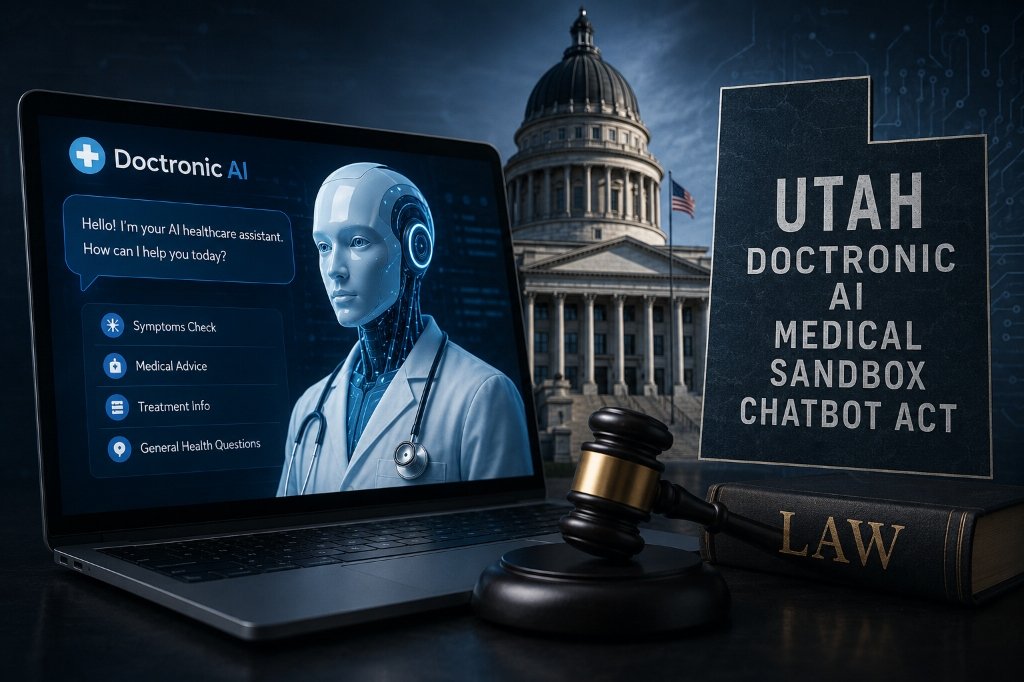
A patient diagnosed with type 2 diabetes or hypertension log into a chat interface, types a few sentences, and receives a legal prescription renewal. No doctor reviews the request. No pharmacist calls to verify clinical changes. Instead, an autonomous algorithm developed by a healthcare technology startup called Doctronic evaluates the patient’s record and issues a 30-, 60-, or 90-day renewal for any of 191 approved chronic care drugs.
This is not a hypothetical vision of corporate healthcare. It began operating in the State of Utah in January 2026 as a first-in-the-nation, 12-month pilot program.
The mechanism that made this possible is Utah’s newly established “AI Learning Laboratory”—a regulatory sandbox administered by the Office of Artificial Intelligence Policy (OAIP) within the Utah Department of Commerce. The sandbox allows companies to test artificial intelligence technologies with temporary relief from specific state laws. By using a regulatory mitigation agreement, Doctronic obtained authorization to bypass traditional medical licensing rules, allowing an algorithm to perform tasks that have historically required a human physician’s credentials.
By April and May 2026, this pilot program had triggered a massive multi-front war involving state regulators, independent medical boards, transparency advocates, and federal lawmakers. The clash is setting the structural ground rules for autonomous practices in regulated industries.
The Core Conflict Matrix
The table below outlines the core positions, arguments, and risks identified by the primary entities involved in the Doctronic controversy.
| Entity | Core Position in 2026 | Primary Argument & Proposed Benefit | Identified Risks & Objections |
|---|---|---|---|
| Doctronic & State of Utah (OAIP) | Maintain the pilot program and gather data within the sandbox framework. | Improves medication adherence, lowers healthcare costs, and reduces administrative wait times for routine refills. | Lack of transparency; potential clinical errors; corporate exemption from public accountability. |
| Utah Medical Licensing Board | Immediately suspend the Doctronic pilot program. | Adjusting dosages, managing side effects, and evaluating drug interactions are clinical duties requiring human judgment. | Patients may be left on inappropriate, outdated, or toxic drug therapies without physical checkups. |
| Federal Lawmakers (H.R. 7985) | Enact the CHATBOT Act to restrict automated professional practices nationwide. | Protects consumers by forcing AI systems to disclose their automated nature and prohibiting unlicensed practice. | Banning automated professionals could slow down operational efficiencies in underserved rural areas. |
Inside the AI Learning Laboratory Sandbox
The Utah Office of Artificial Intelligence Policy established the AI Learning Laboratory to invite corporate innovation by offering temporary legal immunity. Under a standard regulatory mitigation agreement, a participant is allowed to operate outside the bounds of traditional state licensing laws while being monitored by state observers.
In the case of Doctronic, the agreement permitted the startup’s autonomous agent to manage routine, guideline-based prescription renewals. The system was restricted to low-risk therapeutic classes, excluding:
- Controlled substances (opioids, benzodiazepines)
- Attention-deficit disorder stimulants (amphetamines)
- Injectable drug formulations
- Complex pain management regimens
Despite these restrictions, the pilot represented a fundamental departure from standard medical practice. Traditionally, an AI assistant is used as a tool by a licensed physician who retains ultimate legal responsibility for the prescription. In the Utah pilot, the AI acted as the direct practitioner, running through automated diagnostic trees to renew active prescriptions.
The Department of Commerce argued that the sandbox was the only way to study the real-world safety of autonomous systems in a controlled environment. However, the medical establishment viewed the sandbox as a loophole designed to strip licensing boards of their regulatory authority.
The Medical Board Revolt and the Secrecy Clash
In April 2026, the Utah Medical Licensing Board issued a formal, scathing letter demanding the immediate shutdown of the Doctronic program. The board argued that the Office of Artificial Intelligence Policy had exceeded its authority by permitting an unlicensed entity to practice medicine.
According to the licensing board, renewing a prescription for a chronic condition is not a mechanical administrative task. It requires clinical evaluation to identify silent side effects, such as kidney damage from blood pressure medications or changes in blood sugar control. When a human doctor signs off on a renewal, they are confirming that the patient’s physiological markers justify the continued therapy. The board warned that allowing an algorithm to continuously renew prescriptions without periodic physical examinations would lead to patients remaining on inappropriate or dangerous drug regimens.
The tension escalated when independent scientists and physicians requested access to the safety data collected during the first quarter of the pilot. Under the terms of the sandbox, Doctronic is required to report usage data, approval rates, and adverse events to state regulators.
Doctronic refused to release the safety reports, citing “business confidentiality” and the protection of proprietary algorithms. The State of Utah backed the company, refusing to disclose the records under public information requests.
This refusal provoked intense ethical outrage in the medical community. Critics argued that using public citizens as test subjects in a first-of-its-kind medical experiment while keeping the safety data hidden behind corporate secrecy protocols violates basic bioethical standards.
Federal Containment: The CHATBOT Act
The controversy in Utah quickly reached federal lawmakers in Washington. In March 2026, U.S. representatives introduced H.R. 7985, known as the Curbing Harmful AI Tools by Offering Transparency (CHATBOT) Act.
The legislation was designed to address the exact regulatory bypass seen in the Utah sandbox. The CHATBOT Act prohibits any generative AI platform or chatbot from:
- Impersonating a licensed professional, including medical doctors, attorneys, and financial advisors.
- Performing tasks that legally require professional credentials or state licensure without a licensed human directly reviewing and approving the specific output.
- Operating under state-level regulatory sandboxes that attempt to grant exemptions from federal consumer protection or professional licensing standards.
If passed, H.R. 7985 would effectively criminalize autonomous AI prescription platforms like Doctronic, overriding state-level sandbox exemptions. The bill’s sponsors argued that professional licensing exists to protect public safety, and allowing software companies to write their own rules under the guise of state innovation programs creates a dangerous precedent.
The Future of Autonomous Professional Practice
The battle over Doctronic is a clear indicator of how the regulatory debate around artificial intelligence is shifting. It has moved beyond academic discussions about safety and is now focused on legal jurisdiction, professional boundaries, and corporate accountability.
If the Utah sandbox model survives legal challenges from the medical board, other states will likely create similar programs. This could allow AI platforms to independently manage legal contracts, file taxes, or issue financial advice, bypassing the professional associations that have regulated these fields for over a century.
However, the lack of transparency in the Doctronic pilot shows the risk of this approach. When private companies are granted legal relief to test AI on the public, the public has a right to see the results. Hiding safety data behind proprietary claims suggests that the priority of the sandbox is protecting corporate assets rather than public health.
The resolution of this conflict will determine whether AI enters regulated professions as a tool managed by human experts, or as an autonomous force operating under temporary exemptions written by corporate lobbies.